


Introduction: one tap on an app’s terms, and then a call from a company he had never heard of
A man picked up a call from a company he had never dealt with. When he asked where they had got his number, the answer was the loyalty app he used, which had passed his data to a “partner company”. He went back into the app and found that the box consenting to share his data with partners already had a tick in it.
He had not ticked it.
The story ended with an order requiring the company that ran the app to fix its system within 30 days and never again tick consent in advance on a user’s behalf.
It was not the only one. This episode covers 3 more complaints that started with the same question: “Who allowed you to use my data, and can I make you stop?” There are the sales calls for a package that would not stop, the customer who asked an airline to erase his data after seeing news of a breach, and a woman who asked a hospital to erase her entire record. The final answer to her was that it could not be erased.
If you build apps, membership sign-up forms or CRM campaigns, or your business calls customers every day: are you sure your “consent” button would pass?
This is Episode 6 of our “PDPA Real Cases” series. If you missed the earlier episodes: Episode 1 is a company posting that an employee had “left the company”, Episode 2 is 5 real CCTV angle cases, Episode 3 is 5 real HR cases, Episode 4 is posting about tenants’ debts, and Episode 5 is social media dramas the PDPA could not touch. Episode 5 was about private individuals. This episode is about businesses again, from start to finish.
What does valid consent under the Thai PDPA actually look like?
Valid consent must come from the data subject’s own decision, be separate from other terms, state its purpose clearly, and be as easy to withdraw as it was to give. Section 19 sets out this principle, and the Personal Data Protection Committee has issued additional guidelines on requesting consent, which Case 1 in this article cites directly.
In business terms, it comes down to 5 points.
- Ask before or at the time of collection, not after the fact.
- Keep it separate from the terms of service. Do not bury it in paragraph 14 of the Terms.
- State the purpose clearly, for example “sharing your name and phone number with partners so they can offer you products”, not “for your benefit”.
- Make it free. Do not make the service conditional on consent, unless the data is genuinely necessary for that service.
- Make it as easy to withdraw as it was to give, as Section 19, paragraph five, requires.
More importantly, consent is not the only basis. Section 24 provides others, such as contract, legal obligation and legitimate interest, and Cases 2 and 4 show this clearly. Many businesses ask for consent for everything until customers are worn out, even though some of those uses do not need consent at all. For how to choose, see You Don’t Need PDPA Consent for Everything: Pick the Basis.
Here is the overview of the 4 complaints.
| Case | Respondent | What the complainant wanted | Core issue |
|---|---|---|---|
| 1 | The company that runs a loyalty points app | Stop sharing his data with partners when he had not consented | The consent box was ticked automatically; Section 19 |
| 2 | A service provider the complainant was already a customer of | Stop calls and messages offering packages | Contractual basis, the Privacy Notice, and stopping when the customer asks |
| 3 | A low-cost airline | Erase his data after news of a breach in its group | Right to erasure; Section 33 |
| 4 | A hospital | Erase her entire record from the registration system | Healthcare facility law requires records to be kept for at least 5 years |
Before you read on: The stories in this article are summarised from decisions and orders of Expert Committee Panel 2, Office of the Personal Data Protection Committee (PDPC), released to the public. We tell only the facts stated in those documents, add nothing they do not say, and do not identify any person or organisation. Anything marked as commentary or advice is the author’s opinion.
Case 1: A loyalty app pre-ticked the box consenting to share data with partners. Does that breach the PDPA?
It risks a breach. The Committee found that setting the consent box to be ticked automatically could mislead users into giving consent that did not reflect their real intention, which breaches the consent guidelines issued under Section 19. The Committee therefore ordered the company to fix its system within 30 days.
The complainant was a man. It began with a phone call from someone claiming to be calling from another company. When he asked where they had got his data, he was told it came from an application managed by the respondent company, which was used to collect membership points and which passed personal data on to partner companies.
He saw two layers of problems with the app.
- It forced users to accept the terms and conditions and the privacy policy before they could use the app at all.
- It displayed a tick mark (✔) showing that he had already given consent, so his data was disclosed to others without his consent.
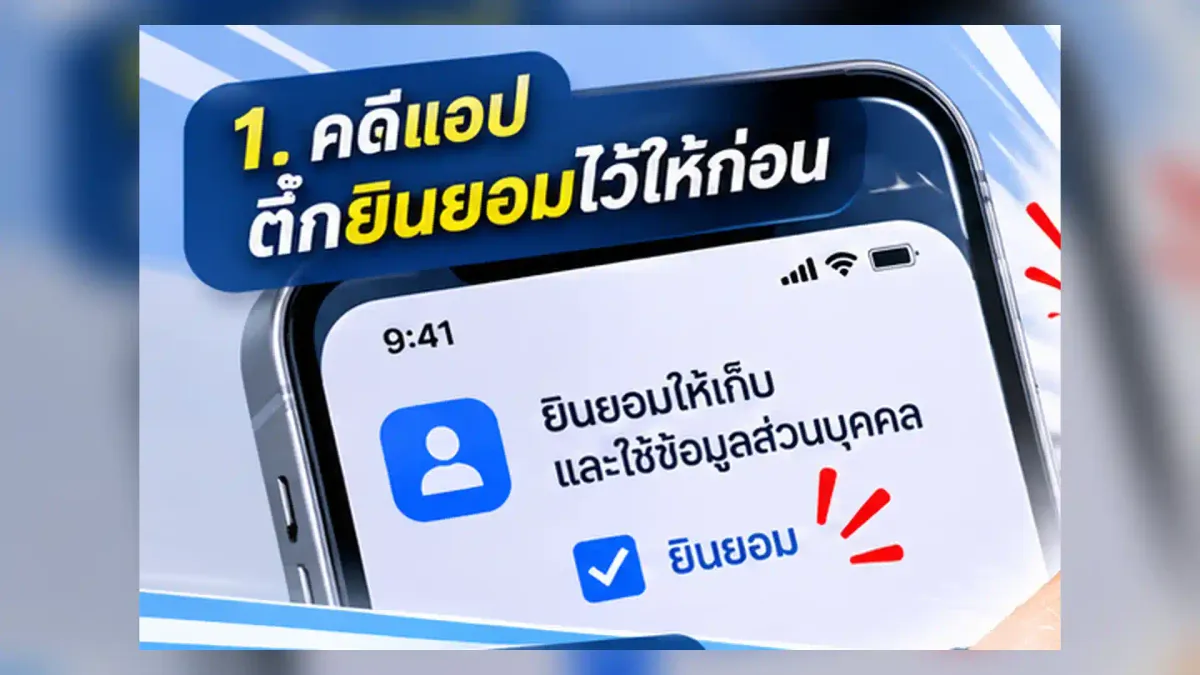
The company replied in writing that the complainant had personally given consent to disclosure to partners on two occasions, and that its consent request was separated by purpose and not mandatory.
The Committee split the issue into two parts, and this is the heart of the case.
| Part of the app | Pre-ticked (default) setting | What the Committee said |
|---|---|---|
| Acceptance of the terms of service | May be pre-ticked | Can be done by electronic means |
| Consent for the company and its partners to use data | The system ticked it automatically after the user accepted the terms | Even though it was separate from the terms, pre-ticking could mislead users into giving consent that did not reflect their real intention |
The Committee added that even if it was done for convenience, it amounted to setting the consent condition in advance, and could be regarded as breaching the guidelines on requesting consent that the Personal Data Protection Committee issued under Section 19.
The order under Section 90 had 3 parts.
- Fix the system that set consent automatically.
- Clearly separate the expression of intent to give consent (opt-in) from agreement to the terms and conditions, so that users decide and tap for themselves, freely.
- Do not set consent in advance or display a mark showing consent before the data subject taps it, within 30 days of receiving the order.
(Order 16/2567, dated 30 April 2024)
Author’s commentary: Notice that the company did not go wrong because it had “no consent box”. It had almost got it right. It had separated the boxes, and it had separated the purposes. Where it slipped was that the system ticked the box by itself after the customer accepted the terms. In other words, it slipped on a single line of code. The marketing team may have thought it saved a step. The UX team may have thought it improved conversion. In the eyes of the law, a box the customer did not tick is not consent.
Regulators abroad treat this far more harshly than Thailand has so far. For example, TechLawNow (Thai) reports how the CNIL fined Fnac EUR 7 million because its app still sent data to a product recommendation system even after users tapped “reject”. If your app uses third-party SDKs, do not check only the screen. Check whether data actually leaves the app when a customer taps “reject”.
For businesses that share data with partners as a matter of routine, a consent button is not enough on its own. You should also have an agreement with each partner setting out who is responsible for what. See the topics that need to be covered in this Thai-language contract guide, a controller-to-controller personal data sharing agreement, and see what consent that passes looks like in the guide to valid consent under the PDPA.
Case 2: A company kept calling and messaging to sell packages to someone who was already a customer. Is that allowed?
In this case the Committee found that the company relied on the contractual basis because the complainant was an existing user, had a Privacy Notice published on its website as Section 23 requires, and stopped contact on every channel as soon as it learned the customer did not want it. The company was therefore treated as having done what the complainant asked.
The complainant was a man. The company called and sent him messages offering packages many times. He considered this a use of his personal data without consent, which distracted him and took up his time, so he asked the company to explain and to stop.

The facts the Committee found were these.
- The company collected, used or disclosed the complainant’s data on the contractual basis, because he was a user of its service.
- The company had both a Privacy Notice and a Privacy Policy published on its website, so it was treated as having complied with Section 23.
- Once it knew the complainant no longer wanted to be contacted about news and benefits, the company stopped on every channel from 31 March 2023.
The Committee therefore found that the company had done what the complainant asked and closed the matter (Decision 33/2566, dated 20 December 2023).
Author’s commentary: This case ended quickly because the company had two things that many businesses still lack. The first is a Privacy Notice that had actually been published, not a draft sitting in a shared drive. The second is a system that could stop contact on every channel once the customer said no, both calls and messages. Not a situation where the team that took the complaint stopped while another team kept calling.
But do not read this case as “once someone is a customer, you can call them to sell anything”. This decision was made on the facts of this case only. In practice, offering other products usually depends on how closely they relate to the existing service, and customers can always object to the use of their data for direct marketing under Section 32. A clear example: TechLawNow (Thai) reports how Italy fined BBVA EUR 5.5 million because customers had opted out of advertising but the system kept sending it for another 7 months. The problem is not the first call. It is failing to stop when the customer says stop.
If you hire an agency or an outside telesales team to call on your behalf, put the do-not-contact list and the duty to stop when a customer objects into the contract as well. See the topics to include in this Thai-language contract guide, an online marketing services agreement. On whether you need consent every time you send promotions to past customers, read Marketing to Past Customers: Is PDPA Consent Needed?
Case 3: He saw news that an affiliated airline had leaked data and asked to have his own data erased. Did the airline have to erase it?
A request like this is an exercise of the right to erasure under Section 33, and in this case the airline erased the data and brought it up to date as the complainant asked. The complainant then withdrew the complaint himself after receiving confirmation that his data had been erased.
The complainant was a man. He saw news on the website haveibeenpwned.com that an affiliated airline that shares its database with the Thai low-cost airline he used had leaked customer data to the public.
He no longer trusted it, so he sent a request asking the airline to erase his data. At first, however, the airline did not act, so he filed a complaint.

What happened next:
- The Committee found that the request was an exercise of the data subject’s right under Section 33(1).
- The airline then erased the personal data and brought the data up to date as the complainant requested.
- There was no disclosure of the complainant’s data to any person or legal entity amounting to a breach.
- The complainant sent an email withdrawing his complaint on 18 December 2024, confirming that his data had been erased.
The Committee closed the matter because there was nothing left to decide (Order 17/2568, dated 7 March 2025).
Author’s commentary: This case tells us two things. First, news of a breach at an affiliated company can lead your customers to ask for erasure even if your own systems were never breached, because trust belongs to the whole group’s brand, not to a single company. Second, the words “did not act” at the start are what brought the matter to a formal complaint. If the airline had answered the customer the first time, this would probably have ended with a single email.
Breaches in the aviation sector are closer than you might think. For example, TechLawNow (Thai) reports how the Amadeus booking system leaked data for more than 3 years, affecting 7 airlines. Every time news like this breaks, a wave of erasure requests follows. Businesses with large customer bases should prepare both their answers to customers and their incident response plan. See Data Breach in Thailand: Your First 72 Hours, Step by Step, and for answering requests on time, PDPA Data Subject Requests: 30-Day and 90-Day Deadlines.
Case 4: She asked a hospital to erase her entire treatment record. Why didn’t the hospital have to?
Because healthcare facility law requires hospitals to keep patient data and treatment data for at least 5 years, and keeping health data for treatment falls within the exception in Section 26(5)(a) of the PDPA. The Committee therefore found that the hospital had not breached the PDPA.
The complainant was a woman. She wanted the hospital to erase her personal data from its entire registration and records system, which the hospital kept under its own rules.
An interesting fact is that the complainant had not reached the age of majority. The hospital had therefore informed her mother, as her statutory representative, of the purposes and obtained her mother’s consent.
The Committee gave 3 layers of reasoning.
- The hospital is a data controller under Section 6.
- The collection, use or disclosure of the complainant’s data is specifically authorised by law, namely Section 35(3) of the Sanatorium Act B.E. 2541 (1998), which requires hospitals to keep personal data and treatment data for at least 5 years.
- It is necessary for compliance with a legal duty for preventive medicine, medical diagnosis, the provision of health services and medical treatment, under Section 26(5)(a) of the PDPA.
The hospital’s conduct therefore did not breach the PDPA, and the Committee closed the matter (Decision 32/2566, dated 20 December 2023).
Author’s commentary: Many people think the right to erasure is a “delete everything” button you can press whenever you like. This case shows it is not. The right to erasure stops where another law requires the data to be kept. Notice also that the Committee did not rely on the mother’s consent as its main reason. It relied on the legal duty, which is stronger, because consent can be withdrawn, but a legal duty cannot.
That point matters for any business that has collected data from a minor through a parent. The consent the hospital obtained was not wrong, and it was obtained from the right person. But consent can be withdrawn, so had it been the only basis, the erasure request would have been much harder to refuse. The legal duty to keep records made that question unnecessary.
The lesson for healthcare businesses is that you must know how many years each type of data must be kept, and under which law, and write it down as a retention schedule. When an erasure request arrives, you can then answer straight away what can be erased, what cannot, and why. For how to answer patients, see Can Patients Erase Medical Records?, and for building the schedule, the guide to PDPA data retention and erasure. For minors, on whose consent is needed and what the paperwork should contain, see Children’s Data in Thailand: Parent or Child Consent?, and the Thai-language contract guide with a sample consent letter from a statutory representative.
Which consent buttons pass, and which are risky?
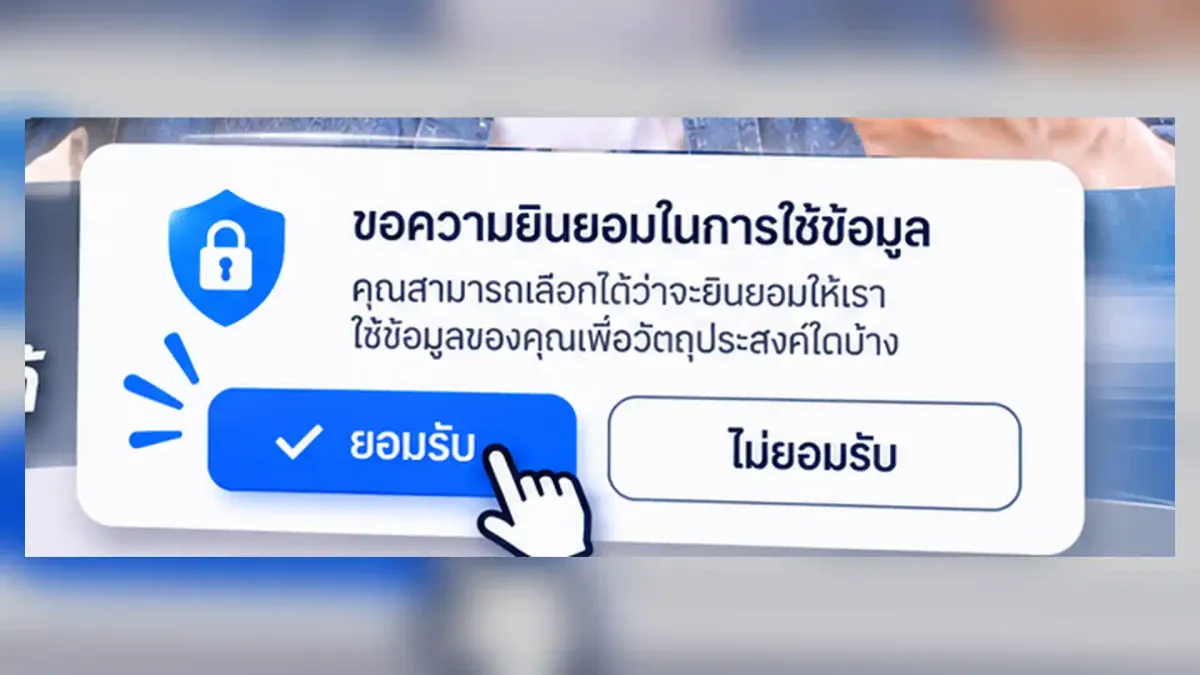
A button passes when the customer taps it themselves, can choose purpose by purpose, and has a “reject” option that is just as clear. A button is risky when anything about it leaves the customer having “already consented” without meaning to. This table translates Case 1 into UX terms.
| Design | Passes or risky | Reason |
|---|---|---|
| Empty consent boxes the customer ticks, separated by purpose | Passes | Matches the order in Case 1 |
| “Accept” and “Reject” buttons of similar size and colour | Passes | The customer has a real choice |
| The box for sharing with partners is ticked in advance | High risk | This is Case 1 exactly |
| The system ticks it automatically after the customer accepts the Terms | High risk | This is Case 1 exactly |
| “By continuing, you consent to everything” | High risk | No separation by purpose and no choice |
| Refusing marketing consent means the app cannot be used | Risky | Ties consent to a service that does not need that data |
| The reject button is faint text hidden at the bottom | Risky | Steers the customer towards accepting |
| Withdrawing consent requires a call or paperwork, but giving it took one tap | Risky | Withdrawal is not as easy as giving consent, contrary to Section 19, paragraph five |
Rows 5 to 8 are the author’s opinion, building on the principle in Case 1 and on Section 19. On how quickly you must stop once consent is withdrawn, read Consent Withdrawn: How Fast Must You Stop?.
A simple way to use this table is to give it to whoever designs your screens and ask them to take a screenshot of every consent point in your app, website and sign-up forms. Then go through the rows one by one. Most problems become obvious the moment someone outside the project looks at the screen with a single question in mind: did the customer make this choice, or did we make it for them?
Sending promotions or making sales calls to customers: which lawful basis applies?
It depends on who is sending, to whom, and what. For existing customers and products related to the existing service, other bases may be available. But passing data to partners so they can sell their own products should rest on separate consent. In every case, customers can object to direct marketing under Section 32.
| Situation | Basis commonly used | Watch out for |
|---|---|---|
| Notices needed for the existing service, such as payment due dates or changes to terms | Contract, Section 24(3) | This is not selling |
| Offering packages or benefits related to the existing service to current customers | Contract or legitimate interest, depending on the facts (Case 2) | Must be stated in the Privacy Notice, and stop immediately when the customer asks |
| Promotions for other products unrelated to the existing service | Usually requires consent | If relying on legitimate interest, carry out an LIA |
| Passing names and numbers to partners so they can sell their own products | Separate consent by purpose (Case 1) | Never pre-tick, and have an agreement with the partner |
| The customer says they do not want further offers | Right to object, Section 32 | Stop on every channel, in every team and with every contractor |
This table is the author’s opinion. The facts differ from business to business. Before deciding to rely on legitimate interest, carry out an assessment using the guide to legitimate interest and the 3-part LIA, and choose the right basis for each activity with the guide to lawful bases under Section 24.
Read across the table and one pattern stands out. The further the marketing moves from the service the customer actually signed up for, the more you need the customer’s own, separate choice. And whichever basis you use at the start, the last row overrides it. Once a customer objects, the basis you relied on no longer matters for that marketing. What matters is whether you stopped.
When a customer asks for erasure, must the business always erase?
Not always. The right to erasure under Section 33 applies when there is a legal ground, such as the data no longer being necessary, consent being withdrawn with no other basis, or an objection being made. But a business may refuse if it still has to keep the data to comply with the law or to exercise legal claims. Cases 3 and 4 show the two sides.
| Request | Can it be erased? | Example in this article |
|---|---|---|
| The customer has stopped using the service, and no law requires the data to be kept | Usually must be erased or anonymised | Case 3, the airline erased it |
| The customer withdraws marketing consent | Stop using it for marketing, but data needed for the contract may still be kept | |
| Data the law requires to be kept, such as medical records or accounting and tax documents | May be refused, but reasons must be given | Case 4, the hospital did not have to erase |
| Data needed as evidence in an unfinished legal case | May be kept for as long as necessary |
The law sets a 30-day deadline for access requests under Section 30, but erasure requests do not have a fixed number of days written in the same way. Even so, staying silent, as in Case 3, is the fastest route to a complaint. The better course is to apply the same standard to every request and answer in writing every time.
What should you check before launching an app, a membership form or a marketing campaign? A 10-point checklist
If you cannot answer any of these, fix that point before you launch. All 10 points come from the 4 cases in this article, and most of them can be fixed within a week without buying a new system.
- No consent box is pre-ticked, on the website, in the app or on paper forms (Case 1).
- No code ticks consent automatically after the customer accepts the Terms. Have the development team check the code itself, not just the screen.
- Consent is separated by purpose. Your own marketing, sharing with partners and analytics must each have their own box.
- The reject button is as visible as the accept button.
- Withdrawing consent is as easy as giving it, and the time of withdrawal is recorded.
- The Privacy Notice has actually been published, and what it says about marketing and partners matches what you really do (Case 2).
- There is a do-not-contact list shared by every team and every contractor. When a customer says stop once, contact must stop on every channel.
- There is a channel for erasure requests, and answers go out within the time you have set. Never stay silent (Case 3).
- There is a data retention schedule showing which data the law requires you to keep, and for how many years, so you can explain why something cannot be erased (Case 4).
- Marketing, UX and telesales teams are trained to understand that consent is the customer’s decision, not a system default.
Point 10 is what keeps the other nine in place over time. To build this skill in your team, see the professional upskilling courses at Skillno (coming soon). For point 6, if you are not sure your Privacy Notice is complete, compare it with the guide to the privacy notice Section 23 requires, or take a quick reading of your whole business with the free 10-point PDPA health check.
What are the risks of getting consent wrong? 4 layers every business owner should know
The risk is not only a fine. It includes orders to fix your systems, civil damages and the loss of customer trust. Case 1 shows that an order to fix things within 30 days on its own already means fixing the app, testing it and releasing a new version under a tight deadline.
| Layer | Risk | Details |
|---|---|---|
| 1 | Orders of the Expert Committee | The Committee may order a controller to remedy or stop its conduct under Section 90, as in Case 1, which allowed 30 days |
| 2 | Administrative fines | Requesting consent in a form that does not meet the legal requirements: a fine of up to THB 1,000,000 under Section 82. Requesting consent by deceiving or misleading the data subject about the purpose, or using or disclosing data without a basis: up to THB 3,000,000 under Section 83. Where sensitive data under Section 26 is involved: up to THB 5,000,000 under Section 84 |
| 3 | Civil liability | The data subject may claim compensation under Section 77, and the court may award punitive damages of up to 2 times under Section 78 |
| 4 | Customer trust | A customer who gets a sales call from an unknown company remembers the name of the app that passed on their data, not the name of the company that called |
The picture of complaints in Thailand makes this even clearer. TechLawNow (Thai) reports PDPA statistics of 4,210 complaints and 1,650 breach incidents, which means data subjects now know their rights and are using them. For an overview of every penalty, see the guide to PDPA penalties.
Let Kooru set up your consent and request-handling system before the next customer complains
Kooru reviews your consent buttons, forms, Privacy Notice and erasure-request process so they are right before you launch an app or a campaign. All 4 cases in this article share one thing: a customer asks who allowed you to use their data, and the business has to be able to answer at once.
1. A gap review of your whole business within 3 business days
Start with Kooru Data Shield, the Assessment package at ฿5,900. Our legal team reviews your consent buttons, forms and documents, then delivers a report with a remediation plan within 3 business days.
2. Consent documents you can use straight away
Use the customer consent form package together with the consent management procedure for organisations and the consent withdrawal notice template, so that both the giving and the withdrawal of consent are fully evidenced.
3. A system for erasure and other rights requests
Use the data subject rights form set so that erasure requests are never left unanswered, and you have evidence of when you answered and why.
4. Monthly DPO service
If your business runs an app, a membership base or a telesales team that uses customer data every day, see Kooru’s DPO as a Service.
Contact us
Message us on LINE @kooru with a short description of where your business asks customers for consent. Kooru’s legal team replies during business hours, and the initial 15-minute consultation is free.
Food for thought
A box the customer did not tick is not consent, even if it was done for convenience.
Consent that is easy to get is consent that is easiest to lose.
When a customer says stop once, every team must stop, not only the team that took the call.
News of a breach at an affiliated company is the erasure request that will land in your inbox tomorrow.
And the question your marketing team should ask before launching a campaign is not “how many sign-ups did we get?” but “if one customer asked when they gave consent, could we answer?”
Frequently asked questions (FAQ) about consent, marketing and the right to erasure
1. Does pre-ticking a consent box for customers breach the Thai PDPA?
It risks a breach. In Order 16/2567 the Expert Committee found that setting the box for consent to share data with partners to be ticked automatically could mislead users and breach the consent guidelines issued under Section 19. It ordered the company to fix the system within 30 days and not to tick consent in advance.
2. Can the box accepting the terms of service be pre-ticked?
In the same order, the Committee found that acceptance of the terms of service can be done by electronic means. The problem lies with consent to use data, which must be separate and tapped by the user freely.
3. Can a company I am already a customer of call me to sell packages?
In Decision 33/2566 the Committee found that the company relied on the contractual basis because the complainant was a user, had published its Privacy Notice, and stopped on every channel once it knew the customer did not want contact. But that outcome depended on the facts of that case. Customers can always object to direct marketing under Section 32.
4. I do not want a company to call me with sales offers again. What should I do?
Tell the company in writing that you object to the use of your data for direct marketing under Section 32, and ask it to stop on every channel. Keep evidence of the date you told them. If they contact you again, you can use that evidence to support a complaint.
5. If I ask a company to erase my data, must it erase it?
It must erase it where there is a ground under Section 33, such as the data no longer being necessary, consent being withdrawn with no other basis, or an objection having been made. In Order 17/2568 the airline erased the complainant’s data after he asked. But a company may refuse if it still has to keep the data by law or to exercise legal claims.
6. Can I ask a hospital to erase my treatment records?
Usually not. In Decision 32/2566 the Committee found that the hospital must keep patient and treatment data for at least 5 years under Section 35(3) of the Sanatorium Act B.E. 2541 (1998), and that keeping it for treatment falls within Section 26(5)(a) of the PDPA.
7. I saw news of a breach at an affiliated company. Can I ask the company I use to erase my data?
Yes. In Order 17/2568 the complainant asked the airline to erase his data after seeing news that an affiliated airline sharing the same database had leaked data. The Committee found this was an exercise of the right under Section 33, and the airline had erased the data.
8. Once I withdraw consent, when must the company stop?
Section 19, paragraph five, requires consent to be as easy to withdraw as it was to give, and the company must stop using the data for that purpose without delay. Withdrawal does not affect anything lawfully done before it, and the company may still keep data it needs under another basis, such as a contract.
9. What do I need to do to share customer data with partners so they can offer products?
Ask for separate consent for this purpose alone, state the partners’ names or categories and the purpose clearly, never pre-tick the box, and put in place a data sharing agreement with each partner setting out who is responsible for what, including stopping use when the customer withdraws consent.
10. What are the penalties for requesting consent in the wrong form?
The Expert Committee may order remedies under Section 90. Requesting consent in a form that does not meet the legal requirements may lead to an administrative fine of up to THB 1,000,000 under Section 82, and deceiving or misleading the data subject about the purpose up to THB 3,000,000 under Section 83. Civil damages under Sections 77 and 78 may also follow.
References
- Expert Committee Panel 2, Office of the Personal Data Protection Committee. (30 Apr 2024). Order 16/2567 on unlawful requests for consent (an application set consent to share data with partners automatically; Sections 19 and 90)
- Expert Committee Panel 2. (20 Dec 2023). Decision 33/2566 (sales calls and messages offering packages; contractual basis; Section 23)
- Expert Committee Panel 2. (7 Mar 2025). Order 17/2568 on bringing data up to date (a request that an airline erase data; Section 33)
- Expert Committee Panel 2. (20 Dec 2023). Decision 32/2566 (a request that a hospital erase records; Section 26(5)(a) and Section 35(3) of the Sanatorium Act)
- Personal Data Protection Act B.E. 2562 (2019), Sections 6, 19, 23, 24, 26, 30, 32, 33, 72, 74, 77, 78, 82, 83, 84 and 90
- Sanatorium Act B.E. 2541 (1998), Section 35(3)
- PDPC Regulation on the Filing, Rejection, Termination, Consideration and Time Frame for Complaints B.E. 2565 (2022), clause 13(6)
- Personal Data Protection Committee. Guidelines on requesting consent from data subjects under Section 19 of the Personal Data Protection Act B.E. 2562 (2019)
- AiPDPA. Articles and guides on consent, marketing, the right to erasure and health data, available at https://aipdpa.com
- TechLawNow. Technology law news (Thai) on CNIL v Fnac, the Garante v BBVA and Amadeus, available at https://techlawnow.com
This article is general information to support business decisions and is not legal advice for any specific case. The stories are summarised from publicly released complaint decisions and orders. Anything marked as the author’s commentary is additional analysis and not part of those documents. We do not name the people or organisations involved so that the focus stays on the principles.
By: Khun Phuwara – Senior Advisor in Business Strategy and Legal-Tech, Kooru
Frequently asked questions
Does pre-ticking a consent box for customers breach the Thai PDPA?
It risks a breach. In Order 16/2567 the Expert Committee found that setting the box for consent to share data with partners to be ticked automatically could mislead users and breach the consent guidelines issued under Section 19. It ordered the company to fix the system within 30 days and not to tick consent in advance.
Can a company I am already a customer of call me to sell packages?
In Decision 33/2566 the Committee found that the company relied on the contractual basis because the complainant was a user, had published its Privacy Notice, and stopped on every channel once it knew the customer did not want contact. But that outcome depended on the facts of that case. Customers can always object to direct marketing under Section 32.
Can I ask a hospital to erase my treatment records?
Usually not. In Decision 32/2566 the Committee found that the hospital must keep patient and treatment data for at least 5 years under Section 35(3) of the Sanatorium Act B.E. 2541 (1998), and that keeping it for treatment falls within Section 26(5)(a) of the PDPA.

About the author: Phuwara Krobtaku
Licensed lawyer no. 477/2558 · Thai Barrister-at-Law · LL.M. Intellectual Property & Information Law (gold medal) · DPOMore than 20 years in IT and digital marketing before law. Founder of Kooru, a tech-law advisory handling PDPA, AI governance and intellectual property for SMEs.