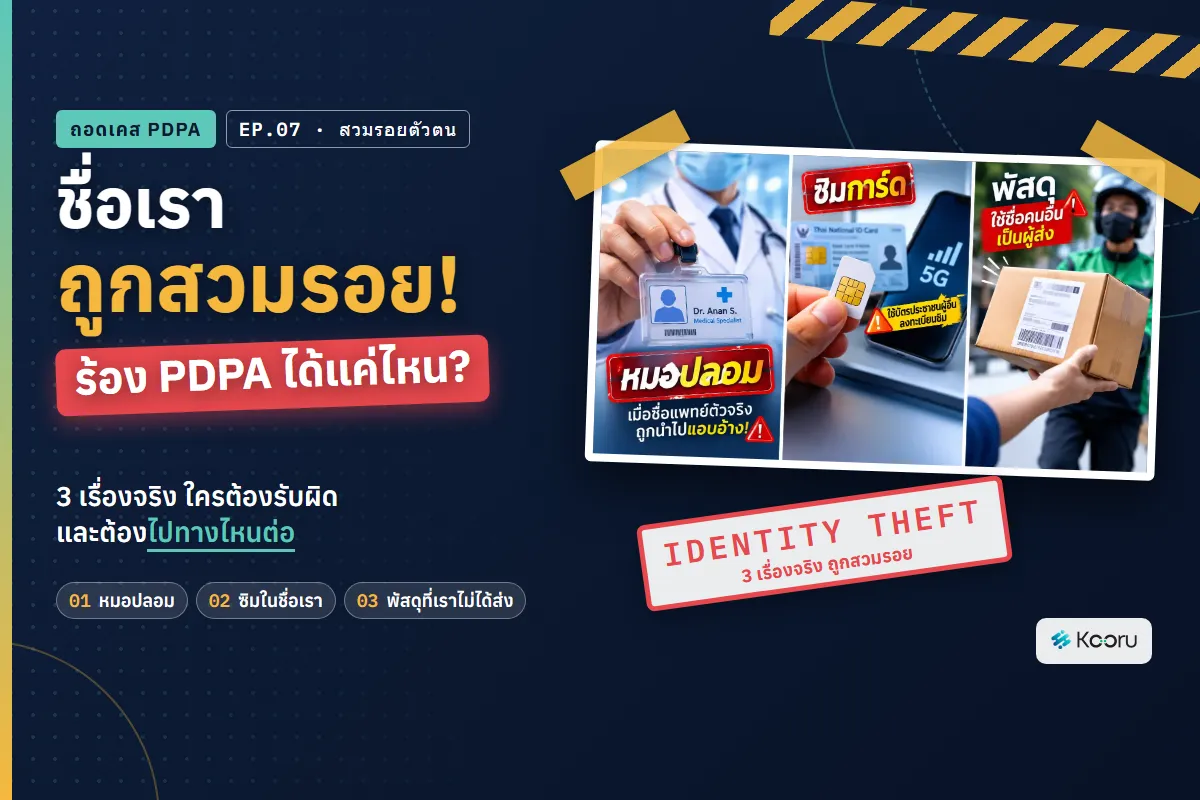


Introduction: two people walked into a bank and asked for his signature to be removed. The answer was “we can’t”
A man lived with his partner as husband and wife without registering the marriage. In 2021 she borrowed from a bank to buy land with a building, and he signed as the consenting spouse. Three years later they went to the bank together and told the officer, verbally, that they wanted his personal data and signature removed from the loan agreement and the loan account.
The officer refused.
He complained to the PDPC Expert Committee, and the outcome had two layers that surprise most people.
First, the Committee held that a verbal request at the counter is a valid exercise of the right to erasure. A bank cannot ignore it because “it has to be in writing”.
Second, the bank was still entitled to refuse, because the loan was still running and the bank needed the data to perform the contract and to protect its legal claims.
The other three cases ask the same question from different angles.
- A life insurance customer ended her policy and asked for deletion, but kept receiving sales calls. The insurer could keep her data for 10 years under the anti-money laundering law, but could not use it for anything else.
- Another life insurance customer ended her policy but was still charged a THB 1,337 premium. Mediation got her the money back and her data anonymised.
- A customer had his ID card scanned when he closed his bank account, without certifying the copy. The Committee found no breach, and the bank destroyed the copy within 7 days.
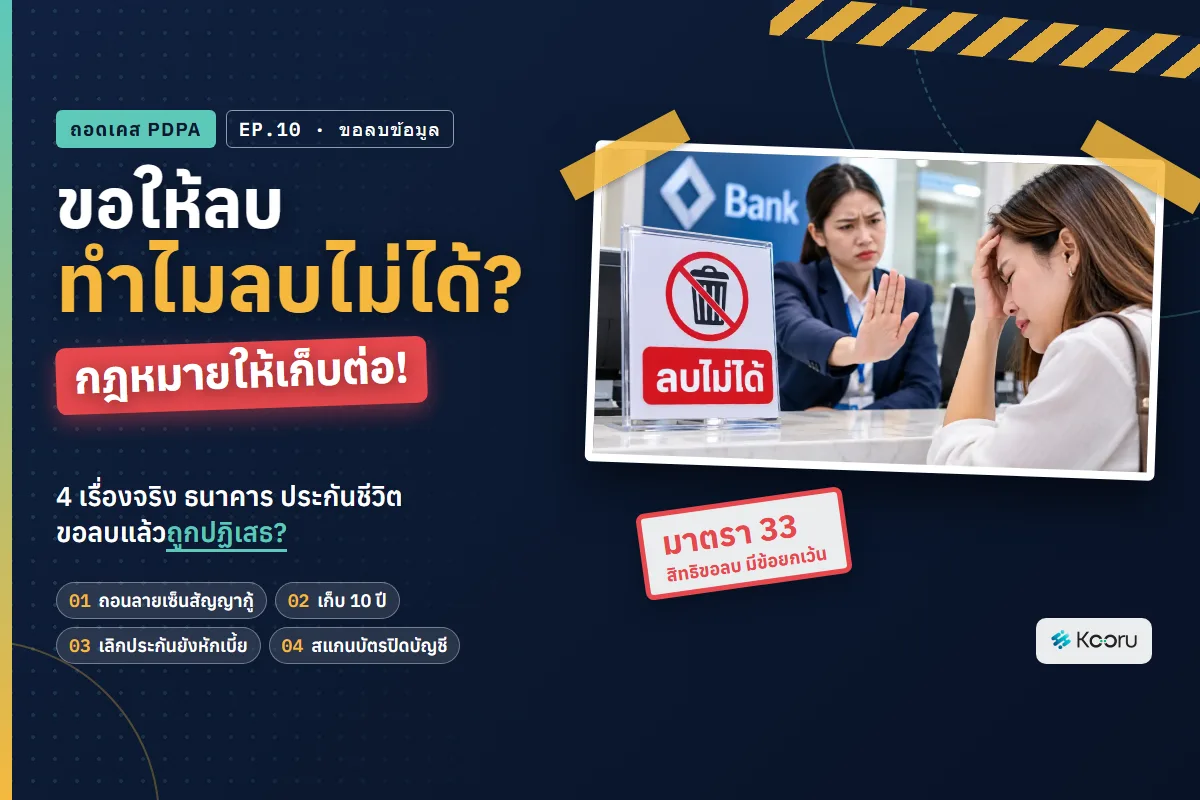
Have you ever asked a company to delete your data? Many people think the PDPA gives an absolute “right to be forgotten”. These four cases show that the truth sits in the middle. If you run a business, the question to ask is: when a customer asks for deletion, does your team know which data must be kept, why, and until when?
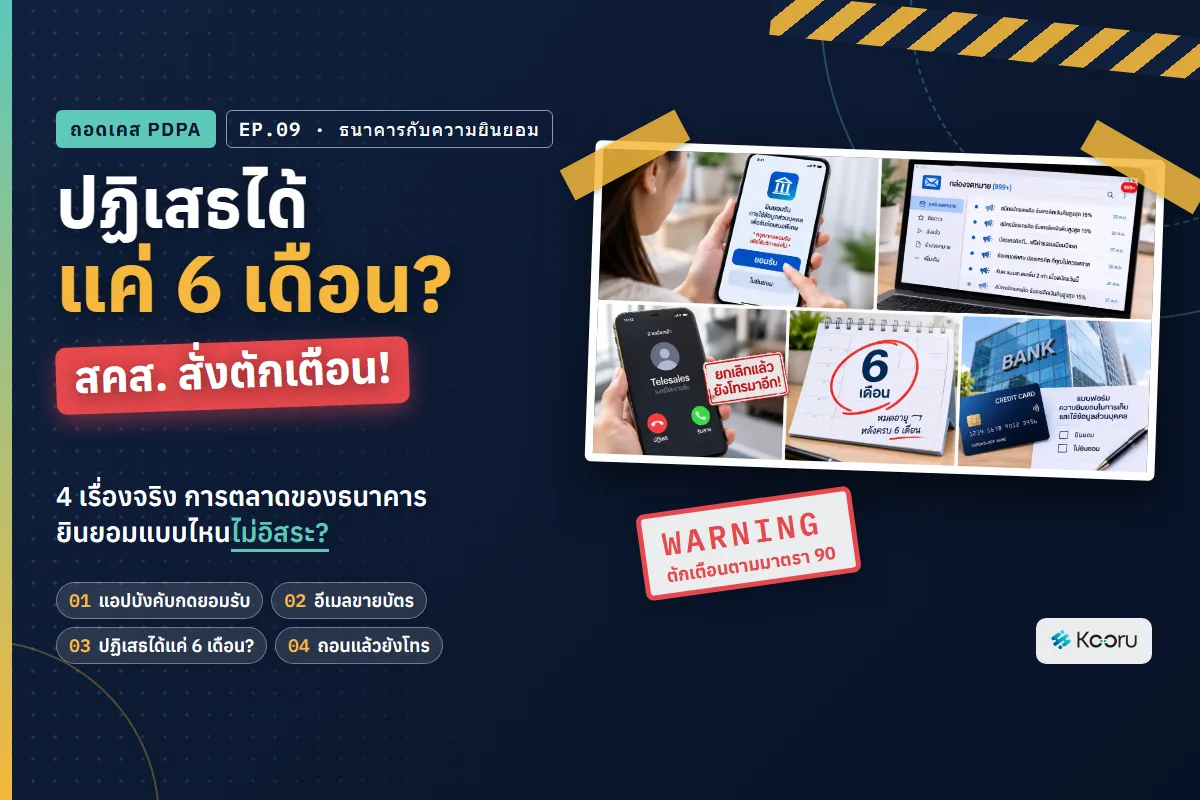
This is EP.10 of our “PDPA Case Files” series and part 3 of the set “Our data in the hands of banks and insurers”. The previous episodes are EP.09 bank marketing and consent and EP.08 insurance sales calls that won’t stop.
What is the right to erasure under the Thai PDPA, and when can a business refuse?
Section 33 lets data subjects ask for their data to be deleted, destroyed or anonymised, but the right is not absolute. A business may refuse where a lawful reason to keep the data remains, such as a contract still in force, another law requiring retention, or the need to establish, exercise or defend legal claims. The four cases in this episode show exactly where that line falls.
Put simply, the right has two sides.
When a customer can ask: for example, the data is no longer necessary for its purpose, the customer has withdrawn consent and there is no other basis, the customer has objected and the business has no ground to reject the objection, or the data has been processed unlawfully.
When a business can refuse: when it still needs to keep the data for a reason the law recognises. In Case 1 the Committee listed them in one paragraph: performance of the contract, acting on the data subject’s request when the contract was made, establishing, exercising or defending legal claims, and compliance with the law.
| Question | Answer from the four cases |
|---|---|
| Can I ask verbally? | Yes. Section 33 prescribes no form (Case 1) |
| Can a business require a written form? | Yes, to manage requests, but only as far as necessary and without undermining the right (Case 1) |
| Can I get deletion while the contract is running? | The business may refuse (Case 1) |
| Once the contract ends, is deletion immediate? | Not always. Another law may require retention, e.g. anti-money laundering (Case 2) |
| Can data kept under that law be used for sales calls? | No. Only for the purpose of that law (Case 2) |
| Does “delete” mean erase everything? | Anonymisation was accepted as compliance (Cases 2 and 3) |
| Is an uncertified ID copy unlawful? | No, if necessary and destroyed on schedule (Case 4) |
Case 1: You verbally asked the bank to remove your signature from a home loan. Can the bank refuse?
Yes, but it must consider the request first. The Committee held that the verbal request at the bank was a valid Section 33 request. Because the loan had not ended, the bank was entitled to refuse, as it still needed the data to perform the contract and for legal claims. The Committee closed the complaint.
The timeline:
- 10 August 2021: the complainant’s partner borrowed from a bank to buy land with a building. He signed as the consenting spouse, although they were not legally married.
- 26 August 2024: they went to the bank together and asked verbally for his personal data and signature to be removed from the loan agreement and the loan account.
- The officer refused. The bank explained that it requires an unregistered partner to sign acknowledging that the property is the borrower’s personal asset, so the partner cannot later claim a half share on the basis that they earned a living together, and so it can enforce the mortgage or a judgment.

Expert Committee Panel 1 set out three points.
- The bank is a data controller under Section 6, as it decides how to collect, use and disclose the data of contract parties and named persons for loans and related transactions.
- Section 33 prescribes no form for the request. The bank’s requirement of a written request is an extra step to manage requests efficiently. It is allowed only as far as necessary and without affecting the substance of the right, for example to verify identity. Since the complainant asked verbally at the bank, which could verify and record the request, he had validly exercised the right. The bank had to consider it under the conditions of the Act and within the legal time frame.
- But the bank could refuse. The loan had not ended, so the bank needed to keep the data to perform the contract that the complainant had signed, or to establish, exercise or defend legal claims, or to comply with the law.
The refusal was therefore not a breach under clause 13(3) of the complaints regulation, and the Committee closed the complaint under Section 74, paragraph 2.
(Decision 13/2568, dated 1 July 2025)
Author’s view: this case has two lessons that belong together.
For customers, a signature on a contract is not something you can “withdraw” like marketing consent. It is part of the evidence the bank relies on to protect its rights in the mortgaged property. While the debt is alive, the right to erasure gives way to the contract and to legal claims. If the relationship has changed, the route is a conversation with the bank about the contract and the security, not a PDPA request.
For businesses, the most important line is not “you may refuse”. It is “a verbal request counts.” Many organisations say rights requests must come through a form, and front-line staff tell customers “we can’t do that” without recording anything. If the request is one the business must honour, the legal clock starts when the customer speaks at the counter, not when the form arrives. The right approach: staff take the request, log it and pass it on. Forms help verify identity. They are not a gate that blocks the right.
Case 2: Your life policy ended and you asked for deletion, yet the insurer keeps calling. Can it keep your data?
It can keep it, but it cannot use it to sell. The Committee found that the insurer could keep the data for 10 years after the policy ended under the Anti-Money Laundering Act B.E. 2542 (1999), but must not use it for any purpose beyond what that law requires. The complaint was closed because the insurer had already anonymised her data.
The complainant, a woman, had a life insurance contract with a company.
- She ended the policy and asked the company to delete and destroy the personal data it held from the contract.
- But she kept receiving calls offering life insurance, which caused her nuisance, so she complained.

Expert Committee Panel 1 found three things.
- The insurer was entitled to keep her data for 10 years after the life insurance contract ended, under the Anti-Money Laundering Act B.E. 2542 (1999).
- The insurer had since deleted her data so that she could no longer be identified, which counted as complying with her request under clause 13(6) of the regulation.
- A caution: data kept after a policy ends must not be used for any purpose other than the one required by law.
The Committee closed the complaint under Section 74.
(Decision 6/2566, dated 31 October 2023)
Author’s view: point 3 is the heart of this case, and many businesses get it wrong.
The anti-money laundering law gives a reason to keep data. It gives no reason to use it. The 10-year archive exists so authorities can check it. If the same names still flow into a sales campaign, that is use beyond purpose, which is exactly why the customer complained.
In practice, separate “data kept because the law requires it” from “data used in daily operations.” When a contract ends, move the record somewhere the sales team cannot reach, with the fewest people able to access it and a clear end date. This follows a similar story in EP.08, where customers said stop and the phone kept ringing.
Note also that the Committee accepted anonymisation as compliance with a deletion request. That helps businesses that still need statistics or accounting records but not the person’s identity. For how a bank chooses between deletion and anonymisation, see AiPDPA’s guide to erasing or anonymising customer data (Thai).
Case 3: The policy ended and you asked for deletion, but the insurer still deducted THB 1,337. How did it end?
In mediation. The insurer refunded the THB 1,337 premium plus the costs she incurred chasing it, and anonymised her data, so she withdrew the complaint. The Committee described the complaint as an exercise of rights under Section 33(1) and Section 33, paragraph 4.
The complainant, another woman, had a story like Case 2, but it cost her money.
- She ended her life insurance contract and asked the company to delete and destroy her personal data.
- The company did not act on the request, and she was still charged a premium of THB 1,337.

Expert Committee Panel 1 found:
- The complaint was an exercise of the data subject’s rights under Section 33(1) and Section 33, paragraph 4.
- The parties then mediated. The insurer agreed to refund the THB 1,337 premium and the other costs she had incurred chasing it, and to delete her data from its database by anonymising it.
- She withdrew the complaint by email, which counted as a withdrawal because the controller had complied, under clause 13(6).
The Committee closed the complaint under Section 74.
(Decision 9/2566, dated 8 December 2023)
Author’s view: this looks small, but it shows a common problem: the contract ended in one system and kept running in another.
The policy team recorded the cancellation, but the direct debit kept running, and the deletion request never reached the system that held the data. The customer only saw money leaving her account. In the end the insurer refunded both the premium and her costs of chasing it, a cost that would not exist if cancellation closed every system at once.
What you need is a list of every system that holds customer data: policy administration, direct debit, CRM, and the sales team’s call lists. When a contract ends or a deletion request arrives, close every item on that list, not just the main system.
Case 4: Your ID card was scanned when you closed your bank account, without certifying the copy. Is that a breach?
No. The Committee held that copying the ID card to close the account was necessary for the bank’s legitimate interests under Section 24(5), so no consent was needed. The bank destroyed the copy 7 days after closure under its procedures, so it collected no more than necessary under Section 22. The complaint was closed.
- The complainant, a man, went to the bank to close his account.
- An officer scanned his ID card. He said the bank kept the copy without his certifying signature and without stating the purpose.
- He wanted the bank to delete and destroy that data.

Expert Committee Panel 1 held:
- The bank is a data controller under Section 6.
- Copying the ID card to close the account at the complainant’s request, even without certification or a stated purpose, was necessary for the bank’s legitimate interests, which were not outweighed by the data subject’s fundamental rights. It fell under Section 24(5), so no consent was needed, and it followed the bank’s procedures.
- The bank deleted and destroyed the copy 7 days after the account was closed (23 January 2023), under its procedures and as the complainant wanted.
- The collection was therefore not more than necessary and complied with Section 22.
The Committee closed the complaint under Section 74.
(Decision 7/2567, dated 11 March 2024)
Author’s view: many Thais believe “if I didn’t sign the copy, the company can’t keep it.” The habit of writing “for … only” on ID copies is still a good one for customers. But legally, the basis for collecting data does not sit in the signature on the copy. It sits in whether the business has a ground under Section 24, and whether it keeps only what is necessary.
The bank won here not by citing a legal basis but because its retention period was written down and actually followed. “Destroyed 7 days after closure” is an answer anyone can check. If your business copies customer ID cards, ask: where is that copy, and on what date is it destroyed? If you can’t answer, the same complaint might not end this well.
How long can a business keep data? Four questions before telling a customer “we can’t delete it”
Before refusing a deletion request, a business should be able to answer four questions: why it keeps the data, until when, who can access it, and what it may be used for. If any answer is missing, the refusal is a risk.
| Question | A good answer | From this episode |
|---|---|---|
| 1. Why keep it? | “The loan has not ended” or “the AML law requires it” | Cases 1 and 2 |
| 2. Until when? | “10 years after the policy ends” or “7 days after account closure” | Cases 2 and 4 |
| 3. Who can access it? | Compliance and audit only, not sales | Case 2 |
| 4. What can it be used for? | Only the purpose of the law relied on | Case 2 |
This table is the author’s view. Section 23 requires the retention period to be disclosed when data is collected, and Section 37(3) requires a controller to have a system to delete or destroy data when the retention period ends or when the data subject asks. A business that does both can say “we can’t delete this, because…” in a way customers accept and the Committee can verify.
How do I ask a bank or insurer to delete my data? Six steps
Say exactly what you want deleted and why, ask for written confirmation, and ask for the legal reason and retention period if refused. If the business may keep the data, ask it to stop using that data for marketing, and complain to the PDPC if money is still deducted or calls continue.
| Step | What to do | Why |
|---|---|---|
| 1 | Say exactly what to delete, e.g. data from an ended policy, your record in marketing lists, or an ID copy | Broad requests tend to get broad answers |
| 2 | Give the reason, e.g. the contract has ended or you withdrew consent | Helps the business check the Section 33 conditions |
| 3 | Ask at the counter if you like, but follow up in writing | A verbal request counts (Case 1), but written proof helps in a dispute |
| 4 | If refused, ask for the reason and the retention period | Valid reasons are limited, such as a live contract or a legal duty to keep |
| 5 | If they may keep it, ask them to stop using it for marketing by objecting or withdrawing consent | Keeping data under a law does not allow sales calls (Case 2) |
| 6 | If money is still deducted, calls continue or you get no answer, complain to the PDPC with all your evidence | Case 3 ended with a refund and anonymisation after a complaint |
These steps are the author’s view. For ready-to-use forms, see the data subject rights form set.
How should a business that holds customer data handle deletion requests? A 10-point checklist
If you can’t answer an item, fix it before the next deletion request arrives. None of the four cases ended in a penalty, but every one cost the business time, refunds or a complaint process that a clear retention schedule and a front-counter request log would have avoided.
- Front-line staff can accept verbal requests and log them immediately (Case 1).
- Forms verify identity. They are not a condition of the right (Case 1).
- Keep a retention schedule by data type and the law relied on (Cases 2 and 4).
- State retention periods in your privacy notice under Section 23.
- Separate data kept for legal reasons from operational systems, out of the sales team’s reach (Case 2).
- List every system that holds customer data, including direct debits and sales call lists (Case 3).
- When a contract ends, close every system at once, not only the main one (Case 3).
- Offer anonymisation for data still needed for statistics or accounts (Cases 2 and 3).
- Have a system to delete or destroy data when retention ends, as Section 37(3) requires, and actually run it (Case 4).
- If you refuse, answer in writing with the legal reason and the date the data will be deleted.
This checklist is the author’s view. Items 1 and 10 can be done within a week and do the most to stop requests turning into complaints.
The “PDPA Case Files” series: our data in the hands of banks and insurers
This set has six episodes (EP.08 to EP.13) on real complaints against banks, insurers and financial institutions. Every story is summarised from decisions of Expert Committee Panel 1.
| Episode | Topic | Key question |
|---|---|---|
| EP.08 | Insurance sales calls that won’t stop | Where did they get my number, and must they stop when I say so? |
| EP.09 | Bank marketing and consent | When is consent in a banking app not free? |
| EP.10 | Deletion requests refused (this episode) | Which laws let banks and insurers keep data? |
| EP.11 | Debt and credit | How far can debt collection go through other people? |
| EP.12 | Who opened my account? | The right to see access logs |
| EP.13 | Insurance claims and the limits of the PDPA | What the PDPA can and can’t fix |
The next episode covers debt and credit, from debt-collection letters sent in unsealed envelopes to collection through third parties.
Let Kooru set up your deletion process and retention schedule, before the next customer complains
Kooru builds retention schedules, a rights-request process that starts at the front counter, and an end-of-contract routine that closes data in every system. All four cases here ask the same question: “Must we keep this data, until when, and who may use it?”
1. A whole-business gap review in 3 working days
Start with the Kooru Data Shield Assessment package at THB 5,900. Our legal team reviews your privacy notice, retention periods and rights-request process, and delivers a report with a fix plan within 3 working days.
2. Rights-request forms and process
Use the data subject rights form set so every request, verbal, by email or by form, is logged, verified and answered on time.
3. Monthly DPO service
If your business holds customer data across many systems, runs long-term contracts or must keep data under sector laws, see Kooru’s DPO as a Service.
Contact us
Message us on LINE @kooru and tell us briefly how customers can ask for deletion today and who answers. Kooru’s legal team replies in business hours, and the first 15-minute consultation is free.
Thoughts to leave you with
The right to erasure is not an eraser. It is a question the business must be able to answer.
A customer speaking at the counter has already asked.
A law that says “keep” never says “sell”.
A contract that ended in one system but still debits in another has not ended.
And the question every business should be able to answer is not “can we delete it?” but “if we can’t, can we tell the customer why, and when we will?”
Frequently asked questions (FAQ) about the right to erasure with banks and insurers
1. Can a bank refuse my request to delete my data?
Yes, if a lawful reason to keep it remains, such as a contract still in force, the need to establish or defend legal claims, or another law requiring retention. In Decision 13/2568 the Committee confirmed a bank could refuse to remove a person’s data from a loan that had not ended.
2. Can I ask verbally, or must it be in writing?
You can ask verbally. Section 33 prescribes no form, and in Decision 13/2568 the Committee treated a verbal request at a bank counter as a valid request. A business may use forms to manage requests or verify identity, but only as far as necessary and without undermining the right.
3. How long can a life insurer keep my data after the policy ends?
In Decision 6/2566 the Committee found a life insurer could keep data for 10 years after the policy ended under the Anti-Money Laundering Act B.E. 2542 (1999), but must not use it for any other purpose. Other businesses may face different periods under their own sector laws.
4. If a company keeps my data under a law, can it call me to sell?
No. A reason to keep data is not a reason to use it for marketing. In Decision 6/2566 the Committee cautioned that data kept after a life policy ends must not be used for any purpose beyond the law that requires it, which rules out sales calls.
5. Does anonymisation count as deletion?
In Decisions 6/2566 and 9/2566 the Committee treated anonymisation as complying with the complainant’s request. Section 33 itself offers anonymisation alongside deletion and destruction, so a business can keep statistics or accounts as long as the person can no longer be identified.
6. My policy ended but premiums are still being deducted. What should I do?
Ask the insurer in writing to stop the deduction, refund the money and delete your data. If nothing changes, you can complain. In Decision 9/2566 the insurer refunded the THB 1,337 premium and the costs of chasing it after mediation. Refunds are also a matter of insurance law and the contract.
7. The bank scanned my ID card without me certifying the copy. Is that unlawful?
In Decision 7/2567 the Committee found no breach. Copying the card was necessary for the bank’s legitimate interests under Section 24(5), so no consent was needed, and the bank destroyed the copy 7 days after the account closed, so it was not more than necessary under Section 22.
8. If a business refuses a deletion request, what answer should I expect?
In the author’s view, a good answer states the legal reason for keeping the data, the retention period, and what the data will still be used for. If you only hear “we can’t delete it”, ask for the answer in writing.
9. Where should a business start fixing its deletion process?
With the two quickest wins. First, let front-line staff accept and log requests through any channel, including verbal requests at the counter. Second, create a retention schedule that names, for each type of data, the law relied on, who may access it and the deletion date.
References
- Expert Committee Panel 1, Office of the Personal Data Protection Commission. (1 Jul 2025). Decision 13/2568: complaint closed (request to remove data and signature from a loan agreement).
- Expert Committee Panel 1. (31 Oct 2023). Decision 6/2566: complaint closed (retention after a life policy ended, 10 years under the AML law).
- Expert Committee Panel 1. (8 Dec 2023). Decision 9/2566: complaint closed (deletion request after a life policy ended, and premium refund).
- Expert Committee Panel 1. (11 Mar 2024). Decision 7/2567: complaint closed (ID card copy at bank account closure).
- Personal Data Protection Act B.E. 2562 (2019), Sections 6, 22, 23, 24, 33, 37 and 74.
- Anti-Money Laundering Act B.E. 2542 (1999), as cited in Decision 6/2566.
- PDPC Regulation on the filing, non-acceptance, termination, consideration and time frames of complaints B.E. 2565 (2022), clauses 13(3) and 13(6), as cited in the decisions.
- AiPDPA. Articles and guides on deletion and anonymisation, https://aipdpa.com/en.
This article is general information for business decisions, not legal advice for a specific case. The stories summarise published complaint decisions. Sections marked as the author’s view or commentary are additional analysis, not part of the decisions. We do not name people or organisations, to keep the focus on the principles.
By: Khun Phuwara, Senior Advisor in Business Strategy and Legal-Tech at Kooru

About the author: Phuwara Krobtaku
Licensed lawyer no. 477/2558 · Thai Barrister-at-Law · LL.M. Intellectual Property & Information Law (gold medal) · DPOMore than 20 years in IT and digital marketing before law. Founder of Kooru, a tech-law advisory handling PDPA, AI governance and intellectual property for SMEs.