

Introduction: one letter, an unsealed envelope, and anyone could read that you owe money
A man received a debt collection letter at home. The envelope was not sealed. Anyone who picked it out of the mailbox could read whom he owed and how much.
He did not wait for someone to open it. He complained straight away.
Expert Committee Panel 1 agreed with him on the main point: sending a collection letter in an unsealed envelope means the sender did not properly keep personal data in paper form confidential. The finding did not stop at the company that folded the envelopes. It reached the bank that owned the debt as well.
What makes it more interesting is how it ended. Nobody was fined. Instead the company had to change its whole mailing line, from spot-checking 1 envelope in 10 to checking every single one.
The other three stories in this episode ask the same question: “who is allowed to know about my debt?”
- A borrower whose lender’s staff chased the debt through another person, so that person learned about it
- A car-loan customer who opened her credit bureau report and found the bank had looked at her credit data every month without ever asking her
- A debtor who complained about a financial institution and three collectors, but whose complaint was not accepted at the first gate because the documents were never sent back

If you are a debtor, these four stories show that the PDPA really helps in some situations and does not help at all in others. If you run a business that collects debts, the question to ask is: of the letters and calls that leave your company every day, how many could someone else read or overhear?
This is EP.11 of our “PDPA Case Files” series and part 4 of the set “Our data in the hands of banks and insurers”. The previous episodes are EP.10 deletion requests refused, EP.09 bank marketing and consent and EP.08 insurance sales calls that won’t stop.
Is debt collection through other people a PDPA breach? The short answer from 4 real cases
Who owes whom and how much is personal data. A creditor may use it to chase the debtor, but must keep it confidential. If others learn about the debt, through an unsealed envelope or a phone call, the creditor is exposed under both the PDPA and the Debt Collection Act B.E. 2558 (2015). Still, none of the four stories ended in a fine, and in one of them the PDPA did not apply at all.
| Question | Answer from the four stories |
|---|---|
| Is sending a collection letter unsealed a problem? | The panel found confidentiality was not properly kept (story 1) |
| A bank hires another company to send letters. Who is responsible? | The bank is the controller, the sender is the processor; both need safeguards (story 1) |
| Can I complain under the PDPA if a debt is chased through someone else? | Yes. This one ended in a settlement, so the panel never ruled on it (story 2) |
| Can I complain if a bank checks my credit bureau report every month without asking? | No. It falls under the credit information law, Section 4(6) (story 3) |
| What if I don’t send the documents the office asks for? | The complaint is not accepted (story 4) |
Story 1: a collection letter arrived unsealed. Is that a PDPA breach, and who is responsible?
The panel found that sending a collection letter without sealing the envelope meant the confidentiality of personal data in paper form was not properly maintained. Once the company overhauled its envelope checks, the panel treated the complainant’s request as fulfilled and closed the complaint.

There were two respondents: a bank and a company the bank had assigned to send collection letters.
- The company sent a collection letter to the complainant without sealing the envelope.
- The complainant argued that the respondents had no proper security measures, and that his data could be disclosed if someone else opened the letter.
Expert Committee Panel 1 set out four points.
- The bank is the data controller under Section 6, because it decides how the complainant’s data is collected, used and disclosed for its commercial banking business and the contract he signed.
- The company that sent the letter is a data processor, because it acted on the bank’s instructions, and the bank must put an agreement in place to control the processor’s work under Section 40, paragraph three.
- Security measures must protect confidentiality and must cover data in every form, paper as well as electronic. Sending the letter unsealed meant the confidentiality of paper-based data was not maintained to prevent unauthorised access.
- The facts showed the company used a machine to fold and seal envelopes and had staff spot-check one in every 10. The panel noted that security measures must include raising staff awareness and communicating policies for staff to follow.
So what did the company change once the panel pointed at its envelope checks?
| Before | After |
|---|---|
| Spot-check 1 envelope in 10 | Check every envelope |
| Folding machine serviced on the old cycle | Serviced once a week or every 1,000 letters |
| Envelopes used as supplied | Envelopes tested before every run |

The panel treated these changes as properly communicating policies and measures for staff to follow. Both the controller and the processor had therefore done what the complainant asked, under clause 13(6) of the complaints regulation, and the panel closed the complaint under Section 74.
(Decision 2/2568, dated 7 February 2025)
Author’s view: three points are worth thinking about.
First, nobody had to wait for an actual leak. The complainant complained because his data “could” be disclosed, and the panel looked at the safeguards, not at whether anyone had opened the letter. For a business, one unsealed envelope is enough to have the whole system examined.
Second, outsourcing the mailing does not outsource the responsibility. The bank was still the controller and still needed a contract controlling its processor. If your business uses a print-and-mail house, a collection agency or a call centre, open the contract and look for a confidentiality clause.
Third, another law covers the same envelope. According to the Department of Provincial Administration’s guide, Section 11(4) of the Debt Collection Act B.E. 2558 prohibits contacting a debtor by postcard, unsealed document or anything else that clearly signals debt collection. Breaching it carries a penalty under Section 39 of up to one year in prison, a fine of up to 100,000 baht, or both. An unsealed envelope is therefore a two-layer risk.
Story 2: a lender’s staff chased the debt through someone else. How did the PDPA complaint end?
It ended in negotiation. The parties settled, the complainant withdrew, and the panel closed the complaint without ruling on whether chasing a debt through another person breaches the PDPA.

- The respondent was a company providing loans and vehicle hire-purchase.
- Its staff chased the debt through a person other than the complainant, so that person learned the complainant’s personal data, causing him harm.
- The complaint was titled “use or disclosure of personal data without consent.”
- The parties later settled the dispute, and the complainant emailed a withdrawal on 23 August 2024, saying he did not want the panel to continue.
The panel found no issue left to decide under clause 13(6) and closed the complaint under Section 74.
(Decision 18/2567, dated 24 October 2024)
Author’s view: do not read this story as “chasing a debt through others is fine.” The panel never ruled on that. The case ended because the company chose to negotiate first, which suggests it saw its own risk.
What makes this serious is that a specific law already covers it. According to the Department of Provincial Administration’s guide:
- Section 8 bars a collector from contacting anyone other than the debtor to collect the debt, except a person the debtor has named. Others may be contacted only to ask about or confirm where the debtor can be reached.
- Section 11(3) bars telling or revealing the debt to anyone not involved. The exception is a spouse, parent or descendant of the debtor who asks why they are being contacted; the collector may explain only as much as is necessary and appropriate. Breaches are punished under Section 39.
- Section 9(2) sets contact hours: Monday to Friday 08:00–20:00 and public holidays 08:00–18:00.
So “please tell Mr S to pay his debt” is not just bad manners. A debtor has more than one route: a PDPC complaint for the personal data side, and a complaint to the debt collection supervisory committee or the police for the collection method.
If the debt chasing ends up on social media or in a LINE group, see the other set of real cases in debt chasing on social media and the PDPA.
Story 3: the bank checks my credit bureau report every month and never asked me. Can I complain under the PDPA?
No. The panel held that the bank’s use of data to check repayment history was processing of a credit information company’s and its members’ data under the credit information business law, so it is outside the PDPA under Section 4(6). The panel closed the complaint.
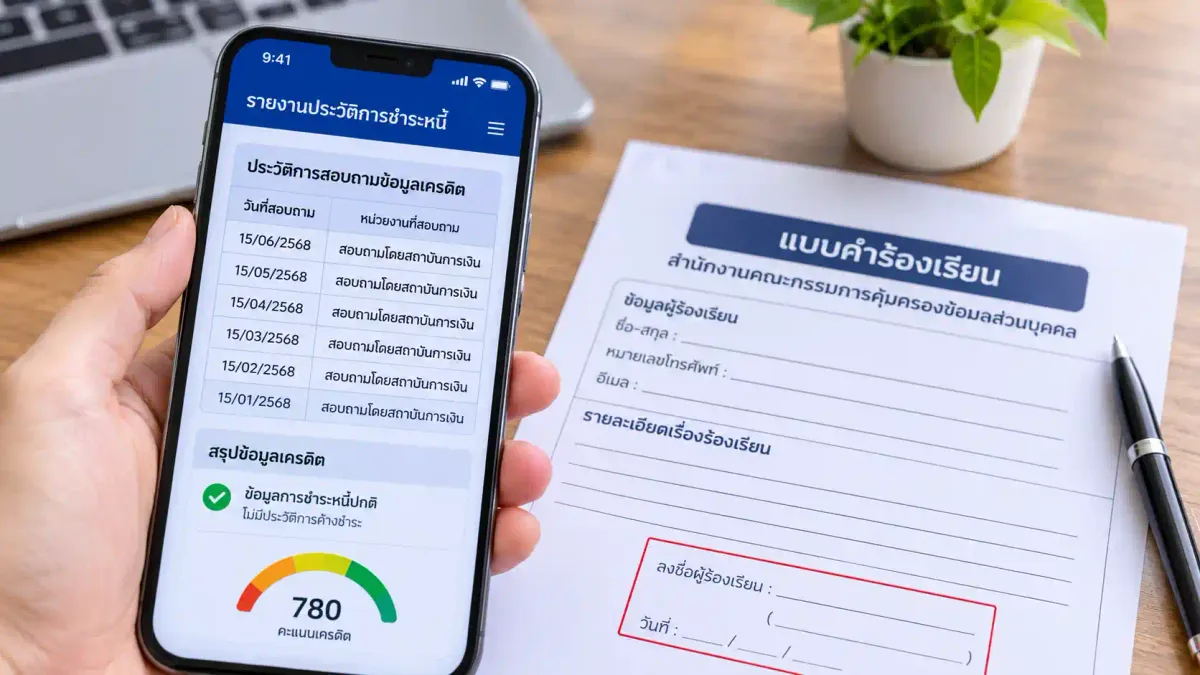
- Around June 2020 the complainant took out a car loan with a bank.
- Around October 2023 she requested her own repayment history report (credit bureau report) from the National Credit Bureau.
- She found that the bank had reviewed her credit every month, without ever writing to her or asking for consent.
Expert Committee Panel 1 found that the bank used and disclosed the data to check her repayment history under a notification of the Credit Information Protection Committee on disclosure to members or service users and data subjects’ consent. That falls within Section 4(6), which excludes processing by credit information companies and their members under the specific law. The bank’s conduct was therefore not subject to the PDPA, and the panel closed the complaint under Section 74.
(Decision 21/2567, dated 6 December 2024)
Author’s view: this is the clearest example that the PDPA is not the single door for every data question. Credit information has its own law and its own regulator. If you want to know who has looked at your credit data and whether they were entitled to, that question belongs under the credit information law, not with the PDPC.
What customers can do themselves is request their own credit report from time to time, as the complainant did, and look at who has made inquiries. An organisation you don’t recognise is where the right question starts.
For businesses, the Section 4 exclusions are not a blanket pass. The last paragraph of Section 4 still requires controllers excluded under (2) to (6) to keep personal data secure to the required standard. And data that does not come from the credit bureau, such as data used for collection or marketing, remains under the PDPA as usual.
Story 4: a complaint against a financial institution and three collectors was not accepted. Why?
Because the complainant never signed the complaint form or sent the supporting documents the office asked for. The panel found the complaint’s details and evidence incorrect or incomplete, and decided not to accept it. Whether the debt collection was unlawful was never examined.
- The complainant named three respondents: a financial institution and two individuals.
- He said the financial institution unlawfully used or disclosed his data, and that he was chased for a debt by the third respondent, who claimed authority from the institution as his employer, although he never consented to the collection and use of his data.
- He wanted all three investigated and prosecuted.
But his complaint was incomplete and not on the form the office requires.
| Date | What the office did | Result |
|---|---|---|
| 17 February 2023 | Emailed a request for documents to the address he had given | No reply |
| 5 April 2023 | Sent a letter by express mail asking him to sign the complaint form with evidence and return it within 15 days | No contact after the deadline |
The panel decided not to accept the complaint under Section 74, paragraph one, together with clause 13(1) of the regulation.
(Decision 2/2566, dated 15 June 2023)
Author’s view: this may be the weightiest story in the episode: a collector claiming delegated authority, no consent, three respondents. Yet nobody looked at the substance, because the documents never arrived.
The lesson for debtors is simple: a complaint needs follow-through. Check the email you gave, check your post, and return the signed form with evidence on time. If you change your email or address, tell the office.
Being chased for a debt like this? 5 steps for debtors
Keep the evidence, work out whether the problem is the data or the collection method, complain to the right body, and follow through. Owing money does not take away your rights over your data, but it does not make the debt disappear either.
| Step | What to do | Why |
|---|---|---|
| 1 | Keep evidence: the envelope with the letter, dates and times of calls, numbers, and who was contacted | Story 1 started from a single envelope |
| 2 | Separate the issues: data disclosed or overused (PDPA), or the wrong collection method, such as chasing others or calling outside hours (Debt Collection Act) | The two laws have different complaint routes |
| 3 | Write to the creditor asking it to stop contacting others and fix how it sends documents | Stories 1 and 2 ended because the creditor fixed things or negotiated |
| 4 | Complain to the right body: PDPC for personal data, the debt collection supervisory committee or police for collection methods, the credit information law for credit data | Story 3 went to the wrong law |
| 5 | Follow through: sign the form and send evidence on time | Story 4 failed for missing documents |
These steps are the author’s view and are not advice to stop paying. Talking to the lender about restructuring is worth doing alongside them.
What should a business that collects debts check? An 8-point checklist
If your business sends collection letters or makes collection calls, in-house or outsourced, go through these eight points. Each one comes from something that actually happened in these four stories.
- Every envelope is sealed before it leaves the mailroom, checked one by one rather than spot-checked (story 1)
- Nothing on the envelope says or signals debt collection
- Folding and sealing machines have a service cycle, and envelopes are tested before every run (story 1)
- There is a contract with every processor: mailing houses, collection agencies and call centres, under Section 40 (story 1)
- A call script: if the person who answers is not the debtor, staff may only ask where the debtor can be reached, and say nothing about the debt (story 2)
- Train staff and record the training; the panel mentioned awareness directly (story 1)
- Keep credit bureau data separate from data used for collection or marketing, because different laws govern them (story 3)
- Have a channel for collection complaints, and settle them before the customer has to go to the PDPC (story 2)
This checklist is the author’s view. Points 1, 5 and 6 can be done within a week. For an overview of PDPA penalties, see the PDPA penalties guide.
The “PDPA Case Files” series: our data in the hands of banks and insurers
This set has six episodes (EP.08 to EP.13) on real complaints against banks, insurers and financial institutions. Every story is summarised from decisions of Expert Committee Panel 1.
| Episode | Topic | Key question |
|---|---|---|
| EP.08 | Insurance sales calls that won’t stop | Where did they get my number, and must they stop when I opt out? |
| EP.09 | Bank marketing and consent | When is consent in a banking app not free? |
| EP.10 | Deletion requests refused | Which laws let banks and insurers keep data? |
| EP.11 | Debt and credit (this episode) | How far can debt collection go through other people? |
| EP.12 | Who opened my account? | The right to see access logs |
| EP.13 | Insurance claims and the limits of the PDPA | Where the PDPA helps and where it doesn’t |
Every decision in the series is collected in one table at Thailand PDPA decisions. The next episode takes on a question many people want answered: who looked at my account, and can I see the access log?
Let Kooru check your collection process and processor contracts before the next envelope goes out
Kooru reviews your mailing process, collection call scripts and contracts with the companies you outsource to, because all four stories here ask the same question: “where does a customer’s debt information go once it leaves the company?”
1. A business-wide gap check in 3 working days
Start with Kooru Data Shield, Assessment package, 5,900 baht. Our legal team reviews your privacy notice, security measures and processor contracts, and sends a report with a fix plan within 3 working days.
2. Monthly DPO service
If your business holds a loan book, uses collection agencies or mails large volumes of documents to customers every month, see Kooru’s DPO as a Service.
Contact us
Message us on LINE @kooru and tell us briefly how your collection letters are sent and who makes the calls. The Kooru legal team replies during business hours, and the first 15-minute consultation is free.
Something to think about
A debt is between the creditor and the debtor, not whoever happens to answer the phone.
One unsealed envelope means checking every envelope that goes out.
Outsource the mailing, and the responsibility stays with you.
And however serious a complaint is, if the documents never arrive, nobody reads it.
The question every business that collects debts should be able to answer is: “if someone else opened the envelope or took the call today, what would they learn about our customer?”
Frequently asked questions (FAQ) on debt collection and the PDPA
1. A collection letter arrived unsealed. Is that a PDPA breach?
In decision 2/2568 the panel found that sending a collection letter unsealed failed to keep paper-based personal data properly confidential. The complaint was closed because the company switched to checking every envelope and tightened its measures. According to the Department of Provincial Administration’s guide, Section 11(4) of the Debt Collection Act also prohibits contacting a debtor by unsealed documents that clearly signal debt collection.
2. A bank hires another company to send collection letters. Who is responsible?
Both. In decision 2/2568 the bank was the controller under Section 6, the sender was the processor, and the bank had to put an agreement in place to control the processor under Section 40, paragraph three.
3. Can a creditor call my relatives or friends about my debt?
According to the Department of Provincial Administration’s guide, Section 8 of the Debt Collection Act allows contacting others only to ask about or confirm where the debtor can be reached, and Section 11(3) prohibits revealing the debt to anyone not involved, except a spouse, parent or descendant who asks why they are being contacted, and then only as far as necessary. On the PDPA side, case 18/2567 ended in a settlement, so the panel did not rule.
4. What hours may collectors call?
According to the Department of Provincial Administration’s guide, Section 9(2) of the Debt Collection Act allows contact in person, by phone or electronically from 08:00 to 20:00 Monday to Friday and from 08:00 to 18:00 on public holidays.
5. A bank checked my credit bureau report without my consent. Is that a PDPA breach?
In decision 21/2567 the panel held it was outside the PDPA under Section 4(6), because it was processing by a credit information company and its members under the credit information business law. That question belongs under the credit information law.
6. Why might the PDPC decline to accept a complaint?
In decision 2/2566 the complainant did not sign the complaint form or send the evidence the office requested by email and by express mail within 15 days, so the panel did not accept the complaint under clause 13(1) of the regulation.
7. If I owe money, do I still have PDPA rights?
Yes. Being in debt does not let a creditor disclose your data to anyone. The creditor must still keep it secure and confidential, while chasing the debtor under the contract is something it may do.
8. Where should a debt-collecting business start?
The author suggests three quick wins: check every envelope before it goes out, give staff a script for when the person answering is not the debtor, and check your outsourcing contracts for a confidentiality clause.
References
- Expert Committee Panel 1, Office of the Personal Data Protection Committee. (7 Feb 2025). Decision 2/2568: appropriate security measures (collection letter sent unsealed)
- Expert Committee Panel 1. (24 Oct 2024). Decision 18/2567: use or disclosure of personal data without consent (debt chased through another person)
- Expert Committee Panel 1. (6 Dec 2024). Decision 21/2567: complaint closed on use and disclosure of personal data (monthly credit checks)
- Expert Committee Panel 1. (15 Jun 2023). Decision 2/2566: complaint not accepted
- Personal Data Protection Act B.E. 2562 (2019), Sections 4, 6, 37, 40 and 74
- Department of Provincial Administration. Guide for debt collection businesses (summary of the Debt Collection Act B.E. 2558 (2015), Sections 8, 9, 11 and 39)
- PDPC Regulation on the filing, non-acceptance, termination, consideration and time frames of complaints, clauses 13(1) and 13(6), as cited in the decisions
- AiPDPA. PDPA penalties guide, https://aipdpa.com/en
This article is general information for business decisions, not legal advice for a specific case. The stories summarise published complaint decisions. Sections marked as the author’s view or commentary are additional analysis, not part of the decisions. We do not name people or organisations, to keep the focus on the principles.
By: Khun Phuwara, Senior Advisor in Business Strategy and Legal-Tech at Kooru

About the author: Phuwara Krobtaku
Licensed lawyer no. 477/2558 · Thai Barrister-at-Law · LL.M. Intellectual Property & Information Law (gold medal) · DPOMore than 20 years in IT and digital marketing before law. Founder of Kooru, a tech-law advisory handling PDPA, AI governance and intellectual property for SMEs.