

Introduction: “someone did access your data, but we can’t tell you who”
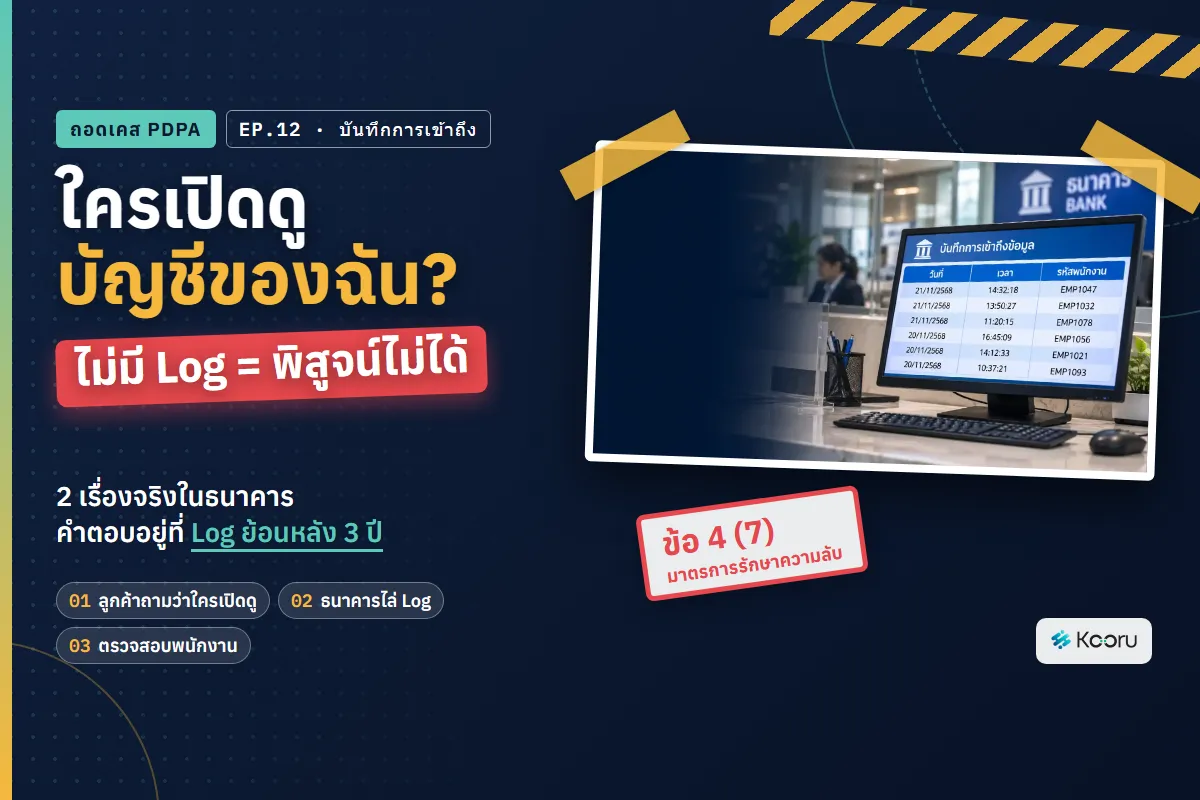
A bank customer suspected that someone had looked up her account. She asked at a branch. The staff told her that someone had indeed accessed her data, but they could not say who.
She wrote to the bank and got the same answer: someone accessed it, but the bank could not say who. So she complained to the Office of the Personal Data Protection Committee (PDPC Office).
The ending: the bank had done nothing wrong. The people who opened her data were branch staff serving her own transactions. The evidence the bank used to prove it was an access log it could read back from 2022 (B.E. 2565) to 2024 (B.E. 2567).
Most articles about logs are about catching wrongdoers. The two cases in this episode show the other side: the log is the only evidence that lets a company prove it did nothing wrong. Without it, “our staff opened the record to serve the customer” is just a claim.
This article follows three threads.
- Why the log is the evidence that protects the company, because it is the only thing that can say who opened the record, when, and why.
- What a usable log must record and how long to keep it, because a customer may come back almost a year after the access.
- What front-line staff should say, because in the first case the customer got a vague answer at the branch and a wrong date by phone.
This is EP.12 of our “PDPA Case Files” series and part 5 of the set “Our data in the hands of banks and insurers”. The previous episodes are EP.11 debt collection through other people, EP.10 deletion requests refused, EP.09 bank marketing and consent and EP.08 insurance sales calls that won’t stop.
Can I ask my bank who looked at my account? The short answer from 2 real cases
Yes, and the bank can answer if it keeps an access log it can read back. In both cases the Expert Committee did not find the bank in breach, because each access had a reason that could be shown: in the first, serving the customer’s own transactions; in the second, an internal investigation to consider disciplinary action against an employee. In the first case, the panel still recommended that the bank tighten its organisational measures on confidentiality.
| Question | Answer from the two cases |
|---|---|
| Is it a PDPA breach when bank staff open my account data? | No, if it is to serve my transactions under the contract, Section 24(3) (case 1) |
| How did the bank prove why the data was opened? | It checked access logs covering 2022 to 2024 (case 1) |
| What happens when staff give the wrong date? | The bank corrected the date from the log; the panel recommended tighter organisational measures (case 1) |
| Can an employer check an account that sent money to an employee’s account? | In this case, yes: it was an internal investigation and consent had been obtained beforehand (case 2) |
Case 1: a customer asked who had looked at her account and the bank could not say. How did it end?
With an order closing the complaint. Expert Committee Panel 1 examined the access log and found no use or disclosure of the complainant’s data beyond serving her own financial transactions, which was performance of a contract under Section 24(3). It recommended that the bank tighten its organisational measures on confidentiality.

The complainant was a customer of a bank. The facts, in the order the document gives them, are as follows.
| Step | What happened |
|---|---|
| 1 | She suspected someone had searched data in her bank account and asked staff at a branch. They said someone had accessed her data, but they could not say who. |
| 2 | She wrote to the bank and was told someone had accessed her data, but the bank could not say who. |
| 3 | She complained to the PDPC Office that the bank had collected, used or disclosed her data for purposes other than those notified, and had used or disclosed it unlawfully. |
| 4 | The bank checked the event log of access to her personal data for 2022 to 2024 (B.E. 2565–2567) and found the access was by its branch staff, to provide financial transactions to her. |
| 5 | On 17 June 2024 she phoned and was told her data had been accessed on 17 July 2023. The bank later explained that this date was wrong: according to the log, the correct date was 12 July 2023, the day she made a transaction at another branch. |

Expert Committee Panel 1 set out three points.
- The bank is the data controller under Section 6, because it runs a commercial banking business and has the power to decide on the collection, use and disclosure of its customers’ data.
- The panel examined the event log itself and found no use or disclosure of the complainant’s data beyond providing financial transactions to her, which was performance of a contract to which she is a party under Section 24(3).
- It recommended that the bank tighten its organisational measures relating to the duty of confidentiality, in line with the PDPA and the PDPC Notification on Security Measures of the Data Controller B.E. 2565, clause 4(7).
The panel ordered the complaint closed under Section 74, paragraph two, which applies where a complaint is found to have no ground.
(Order 8/2568, dated 22 April 2025)
Author’s view: three points are worth thinking about.
First, the bank had done nothing wrong, yet the case still reached the PDPC Office. The sequence in the order shows that the customer asked at the branch and heard “someone accessed it, but we can’t say who”, asked in writing and heard the same, and when she phoned she was given the wrong date. Answers like these give a customer more reason to suspect, not less.
Second, the correct date matched a day the customer herself made a transaction. That is what made the bank’s explanation credible. When the date in the log matches the customer’s own transaction, the access has a reason behind it. If the bank had no log, or a log that could only say “someone looked”, it would have had nothing to show the panel.
Third, clause 4(7), which the panel cited, is about raising awareness and communicating policies to staff so that they know and follow them. In the author’s view, the recommendation points at people rather than systems. The bank’s system had a log that could be checked; the staff answering the customer did not yet know how to answer or where to check the date.
Case 2: a bank examined an account that sent money to an employee’s account. Is that a PDPA breach?
Not in this case. The panel found it was an internal investigation to establish facts for considering disciplinary action, and that the bank had obtained consent beforehand for searching the financial data in the counterparty’s account. As the complainant had also withdrawn, the panel decided not to accept the complaint.

- The complainant was an employee of a financial institution.
- She complained that the bank examined the financial data of an account held by one of its contract counterparties, which showed transfers linked to her own account.
- She said she had not consented to the collection, use or disclosure of that account’s data, and asked for the bank to be investigated under the PDPA.
Expert Committee Panel 1 found that:
- The complainant was the bank’s employee, and the bank’s action fell within the company’s investigative authority, to establish the facts for considering disciplinary action against an employee.
- For searching financial data in the counterparty’s account, the bank had obtained consent beforehand.
- There was therefore no offence under the PDPA, and the complainant had also asked to withdraw her complaint.
The panel decided not to accept the complaint under Section 74, paragraph two, together with clause 13(6) of the PDPC Regulation on the filing, non-acceptance, termination, consideration and time frames of complaints B.E. 2565.
(Decision 3/2566, dated 14 July 2023)
Author’s view: this is the other side of the same question. In case 1 a customer asked who looked at her data. Here an employee asked whether her employer was entitled to look at data linked to her. The panel’s answer rested on two facts: the check had a clear purpose (establishing facts for discipline) and consent for searching the counterparty’s account was in place beforehand.
Businesses using this case as a guide should note two things.
- Consent under the PDPA comes with conditions. Section 19 says the controller “shall utmost take into account that the data subject’s consent is freely given”, and consent can be withdrawn at any time. In the author’s view, consent between employer and employee can be challenged on whether it was freely given, so a company should also consider another legal basis, such as legitimate interests under Section 24(5), and record its reasons before the check begins.
- The decision is short and does not say from whom or in what form consent was obtained. It should not be read as “an employer may check any account when it suspects an employee.” What it does show is that a check with a clear purpose and a basis in place before it starts led the panel to find no offence.
An internal investigation also leaves its own trace in the log. If an employee or customer later asks who opened that account, the log should be able to say it was internal audit, under which investigation number. For more real complaints involving employee data, see PDPA case files on HR.
What must a usable access log record, and how long should it be kept?
A usable log must answer four questions: who opened the record, when, whose data it was, and for which transaction or task. As for how long to keep it, the PDPA sets no number; the company has to set a period long enough to cover the time in which a customer may come back and ask. Case 1 shows that this can be almost a year.
The legal basis has two layers.
- Section 37(1) requires the controller to “provide appropriate security measures for preventing the unauthorized or unlawful loss, access to, use, alteration, correction or disclosure of Personal Data”, in accordance with the minimum standard set by the Committee.
- Clause 4(6)(d) of the Security Measures Notification B.E. 2565 requires “methods enabling retrospective verification concerning access to, alteration, correction or deletion of personal data (audit trails), appropriate to the methods and media used in the collection, use or disclosure of personal data.”
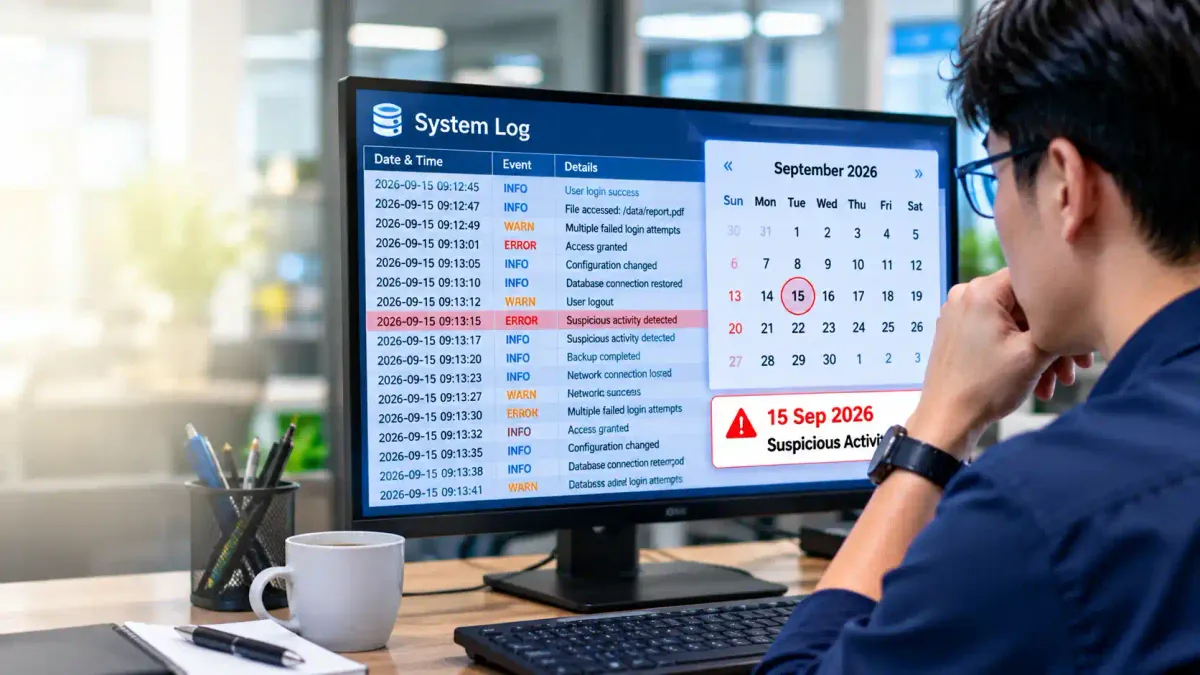
The Notification does not list the fields a log must contain. The table below is the author’s view, worked back from what the bank in case 1 had to be able to answer.
| Log field | Why it is needed | What happens without it |
|---|---|---|
| Who (individual user ID) | You must be able to point to which employee, in which role | Shared accounts leave you able to say only “someone looked” |
| When (date and time) | You must be able to match it to the customer’s transactions | A wrong date, as in case 1, and no explanation |
| Whose data (customer or account number) | You must be able to search back by customer | Searching the whole system to find one customer |
| What action (view, edit, delete, print, export) | Clause 4(6)(d) covers access, alteration, correction and deletion | You cannot tell a look from an export |
| Where (branch, terminal or channel) | In case 1 the correct date was a transaction at another branch | You cannot explain why a branch the customer never visited opened the file |
| Why (transaction, complaint or investigation reference) | This turns “someone looked” into “looked for this transaction” | You are left guessing from the date |
How long? Neither the PDPA nor clause 4 of the Notification sets a retention period for logs.
Many companies quote 90 days from Section 26 of the Computer-Related Crime Act B.E. 2550 (2007), under which “a service provider shall maintain traffic data for a period not less than ninety days as from the date on which such data was entered into the computer system.” But that section applies to “service providers” as defined in Section 3, and to “computer traffic data”, which is data about the communications of a computer system, not a record of which employee opened which customer file. And 90 days is a minimum, not a maximum. For how log retention sits with erasure requests, see 90-day logs and the right to erasure.
The dates in case 1 make the point more clearly. The access took place on 12 July 2023, and the customer phoned on 17 June 2024, 341 days later. The panel’s order came on 22 April 2025. Had the bank kept logs for only 90 days, the record of that day would have been gone long before she called.
In the author’s view, log retention should be set from two things: how long after an access a customer or employee may come back to ask or complain, and how long a complaint takes to be decided. Write that period into the record of processing under Section 39, item (4) of which already has to state “the retention period of the Personal Data”. Because a log holds both customer data and employee IDs, it is itself personal data, and access to it must be restricted too.
A customer asks “who looked at my data?” What should front-line staff say?
Do not say “someone looked, but we can’t tell you who.” Take the request in writing, pass it to whoever looks after the logs or the data protection officer (DPO), and reply in writing with the role of the staff member, the date and the transaction concerned. An answer at the level of role and purpose is what the bank in case 1 used to explain itself, and the panel closed the complaint.
Section 30 gives data subjects the right “to request access to and obtain copy of the Personal Data related to him or her”, and requires the controller to act “without delay, but shall not exceed thirty days from the date of receiving such request.” The PDPA has no section that says outright that a customer may demand the names of the staff who opened their data. But Section 39(5) requires the record of processing, kept so that data subjects and the PDPC Office can check it, to include “the conditions regarding the Person having the right to access the Personal Data”.
The script below is the author’s view.
| Step | What staff say or do | Why |
|---|---|---|
| 1 | “Let me take your question in writing, with the dates you are concerned about.” | It starts the Section 30 clock and lets the log be searched for the right period |
| 2 | “The team that looks after access records will check and reply in writing within 30 days.” | Counter staff should not guess from their screen |
| 3 | Give no dates or names before the log is checked | In case 1 the date given by phone was wrong |
| 4 | Reply in writing: which role, which branch, which date, for which transaction | It can be verified and does not expose staff names, which are the staff member’s own personal data |
| 5 | If the log shows access with no transaction behind it, start the breach process at once | Section 37(4) requires notifying the PDPC Office within 72 hours of becoming aware, unless the breach is unlikely to result in a risk to the rights and freedoms of persons |
Checklists for companies and for customers
Companies need logs that say who, when, whose data and why, and staff trained to answer from the log, not from memory. Customers should ask in writing, give a date range, and compare the answer with their own transaction dates. Both checklists are the author’s view.
For companies: 7 points
- Every employee has their own user ID; no shared accounts, so that the log can say who opened the record, which the branch in case 1 could not
- Access only as far as the job needs, the need-to-know and least-privilege principles in clause 4(6)(a) of the Notification
- The log has all six fields: who, when, whose data, what action, where and why
- Set the log retention period in writing, longer than the time in which customers may come back to ask, and record it under Section 39 (341 days in case 1)
- Test it: pull one customer’s log for the past year and time how long it takes
- Have a counter script and train staff on it, in line with clause 4(7), which the panel cited in case 1
- Before an internal investigation that opens linked accounts or data, record the purpose and the legal basis first, and tie the log entries to the investigation number (case 2)
For customers: 4 points
- Ask in writing or by email and keep a copy; a question asked at the counter leaves no record
- Give the date range you are concerned about, and ask which role accessed the data and for which transaction
- Compare the answer with your own transaction dates from your passbook or the statement in your banking app; in case 1 the correct date was a day the customer made a transaction herself
- If you get no answer within 30 days, or an answer with no detail, then complain to the PDPC Office with a copy of your earlier request
The “PDPA Case Files” series: our data in the hands of banks and insurers
This set has six episodes (EP.08 to EP.13) on real complaints against banks, insurers and financial institutions. Every story is summarised from decisions of Expert Committee Panel 1.
| Episode | Topic | Key question |
|---|---|---|
| EP.08 | Insurance sales calls that won’t stop | Where did they get my number, and must they stop when I opt out? |
| EP.09 | Bank marketing and consent | When is consent in a banking app not free? |
| EP.10 | Deletion requests refused | Which laws let banks and insurers keep data? |
| EP.11 | Debt and credit | How far can debt collection go through other people? |
| EP.12 | Who opened my account? (this episode) | Whom does an access log protect, and what must it record? |
| EP.13 | Insurance claims and the limits of the PDPA | Where the PDPA helps and where it doesn’t |
Every decision in the series is collected in one table at Thailand PDPA decisions. The next episode closes this set, with insurance claims and the matters that fall outside the PDPA.
Let Kooru check your access logs and counter script before the next customer asks
Kooru — PDPA & AI law advisory for Thai businesses — checks whether the logs on the systems holding your customer data can say who, when, whose data and why, and drafts a script for answering customer rights requests. Both cases here came down to one question: “can the company prove why it opened the data?”
1. A business-wide gap check in 3 working days
Start with Kooru Data Shield, Assessment package, 5,900 baht. Our legal team reviews your privacy notice and security measures, including access control and logging, and sends a report with a fix plan within 3 working days.
2. Monthly DPO service
If staff across several branches open customer data every day, or your internal audit team needs to open account data, see Kooru’s DPO as a Service.
Contact us
Message us on LINE @kooru and tell us briefly what your systems log and how long the logs are kept. The Kooru legal team replies during business hours, and the first 15-minute consultation is free.
Something to think about
The bank in case 1 had done nothing wrong, yet from the day the data was opened (12 July 2023) to the order closing the complaint (22 April 2025) took about one year and nine months.
The case closed because the bank still had the log for that day to check, not because of the staff’s explanation.
Author’s view on the next 6 to 24 months: the author expects “who looked at my data?” to become a request businesses receive more often, because case 1 has shown that the question can be answered from a log. And as companies start letting AI tools read customer data in place of staff, the log will also need to say which tool opened the data and on whose instruction. Companies that prepare their logs and scripts now will answer this question within days. Those that do not will be answering it to the expert committee instead.
The question every business that holds customer data should be able to answer is: “if a customer asked today who opened their data last year, could we tell them?”
Frequently asked questions (FAQ) on access logs and the PDPA
1. What is an access log?
It is a system record of who viewed, changed, deleted or exported which customer’s data, and when. Clause 4(6)(d) of the PDPC Notification on Security Measures of the Data Controller B.E. 2565 (2022) calls these audit trails and requires controllers to provide them in a way appropriate to the methods and media used.
2. Can a customer ask a bank who looked at their account?
Yes. In order 8/2568 the customer asked at the branch and in writing. The bank checked its logs for 2022 to 2024 and explained that branch staff had opened the data to serve her transactions. The PDPA has no section that says outright that staff names must be given, but Section 30 gives a right to access one’s own personal data, and the controller must act within 30 days.
3. Is it a PDPA breach when bank staff open my account data?
Not if it is to serve your transactions under the contract. In order 8/2568 the panel found that access to provide financial transactions to the complainant was performance of a contract under Section 24(3), and closed the complaint under Section 74, paragraph two.
4. How long must access logs be kept under the PDPA?
Neither the PDPA nor the 2022 Security Measures Notification sets a number. The 90-day figure comes from Section 26 of the Computer-Related Crime Act, which applies to service providers and computer traffic data, and is a minimum. In order 8/2568 the customer phoned on 17 June 2024, 341 days after the access. The author suggests setting a retention period that covers at least that kind of gap.
5. Can an employer check an account that sent money to an employee?
In decision 3/2566 the panel found the check fell within the company’s investigative authority to establish facts for disciplinary action, and that the bank had obtained consent beforehand for searching the counterparty’s account, so there was no offence. That does not mean an employer may check any account; it needs a clear purpose and a legal basis in place before it starts.
6. Can employee consent be the basis for an internal investigation?
Section 19 requires the controller to take utmost account of whether consent is freely given, and consent can be withdrawn at any time. In the author’s view, between employer and employee a company should also consider legitimate interests under Section 24(5) and record its reasons before the check.
7. What if the log shows someone opened data with no transaction behind it?
Treat it as a possible personal data breach. Section 37(4) requires notifying the PDPC Office without delay and, where feasible, within 72 hours of becoming aware, unless the breach is unlikely to result in a risk to the rights and freedoms of persons. If the risk is high, the data subject must be told as well.
References
- Expert Committee Panel 1, Office of the Personal Data Protection Committee. (22 Apr 2025). Order 8/2568: complaint closed on the collection, use or disclosure of personal data (customer asking who accessed her account)
- Expert Committee Panel 1. (14 Jul 2023). Decision 3/2566: complaint not accepted (internal investigation of an account linked to an employee)
- Personal Data Protection Act B.E. 2562 (2019), Sections 6, 19, 24, 30, 37, 39 and 74
- PDPC Notification on Security Measures of the Data Controller B.E. 2565 (2022), clauses 4(6) and 4(7) (Royal Gazette vol. 139, special part 140 D, 20 June 2022)
- Computer-Related Crime Act B.E. 2550 (2007), Sections 3 and 26 (as amended by Act No. 2 B.E. 2560 (2017))
- PDPC Regulation on the filing, non-acceptance, termination, consideration and time frames of complaints B.E. 2565, clause 13(6), as cited in the decision
- AiPDPA. 90-day logs and the right to erasure, https://aipdpa.com/en
This article is general information for business decisions, not legal advice for a specific case. The stories summarise published complaint orders and decisions. Sections marked as the author’s view are additional analysis, not part of the decisions. We do not name people, organisations or branches, to keep the focus on the principles. Statutory quotations in English are from unofficial translations; the Thai text governs.
Legal analysis and review by: Phuwara Krobtaku, Thai Barrister (licence 477/2558) · LL.M. IP & Information Law · DPO | Founder of Kooru — PDPA & AI law advisory for Thai businesses

About the author: Phuwara Krobtaku
Licensed lawyer no. 477/2558 · Thai Barrister-at-Law · LL.M. Intellectual Property & Information Law (gold medal) · DPOMore than 20 years in IT and digital marketing before law. Founder of Kooru, a tech-law advisory handling PDPA, AI governance and intellectual property for SMEs.