

Introduction: can every data leak go straight to the PDPC Office?
Many people assume that once their data is disclosed without consent, they can file a complaint with the Office of the Personal Data Protection Committee (PDPC Office) and the case will be heard. All three real cases in this episode stopped before the committee asked who was at fault.
In the first, a company complained that a bank had disclosed the company’s account data to an opposing party. The complaint was not accepted, because a company is not a “person” under the PDPA.
In the second, a life-insurance agent admitted telling a customer’s elder brother about the customer’s loan against his policy, and the brother’s side used it in cross-examination in court, where the customer lost. The complaint was not accepted either, because the disclosure happened in March 2022, before the PDPA applied to the insurance business.
In the third, a driver complained against six respondents: the insurer, two directors, the surveyor, a claims director and an employee. The committee considered only the company, and found that it had collected, used and disclosed her data lawfully on almost every point. Yet the insurer was still warned, because it had no agreement with the surveyor who collected the data on its behalf.
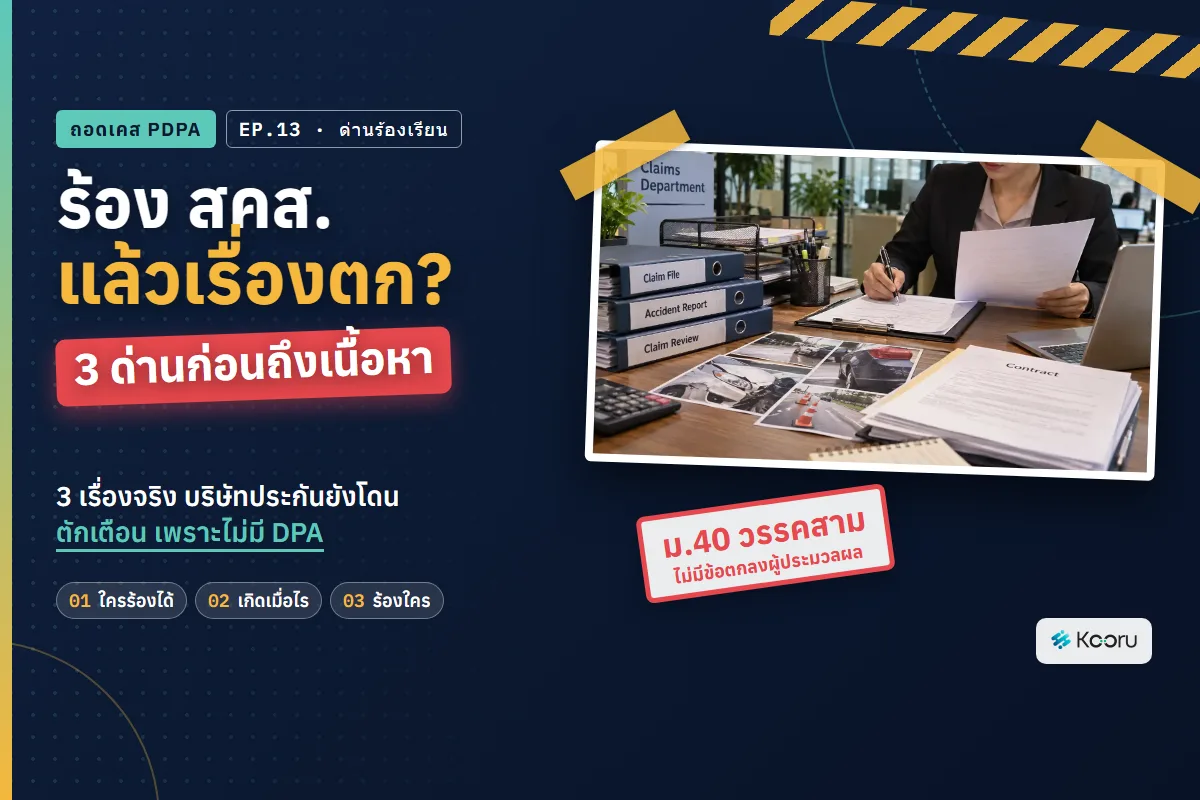
This article follows the three gates in the order the committee checks them.
- Who can complain: only a natural person who owns the data; a company cannot (15/2568)
- When it happened: the event must fall within the period in which the PDPA applied to that business (1/2568)
- Whom to complain about: the organisation acting as data controller, not its directors or staff (20/2567)
Each gate ends with what you can still do if you are stopped there, and the article closes with the document the insurer in the third case forgot.
This is EP.13, the last episode of the set “Our data in the hands of banks and insurers” in our “PDPA Case Files” series. The previous episodes are EP.12 who opened my account, EP.11 debt collection through other people, EP.10 deletion requests refused, EP.09 bank marketing and consent and EP.08 insurance sales calls that won’t stop.
Why do PDPA complaints get rejected? The short answer from 3 real cases
Before looking at fault, the Expert Committee checks three things: whether the complainant is a natural person who owns the data, whether the event happened while the PDPA applied, and whether the respondent is a data controller. Fail any one, and the complaint is not accepted, or some respondents are dropped.
The Expert Committee is the body set up under the PDPA to decide complaints. All three cases here were decided by Panel 1.
| Gate | Question | The real case stopped there | Outcome |
|---|---|---|---|
| 1 | Who can complain | A company complained that a bank disclosed its account data (15/2568) | Not accepted: “person” in Section 6 means a natural person |
| 2 | When it happened | A life-insurance agent disclosed policy-loan details in March 2022 (1/2568) | Not accepted: the insurance business was exempt until 31 May 2022 |
| 3 | Whom to complain about | A driver complained against an insurer, its directors, the surveyor and staff, six in all (20/2567) | Four directors and staff not accepted; the company considered as data controller |
| Past the gates | Was the company at fault? | The same case as gate 3 | Collection, use, disclosure and refusing erasure all lawful, but a warning for having no agreement with the surveyor |
Gate 1, who can complain: a company says its bank disclosed its account data. Why was the complaint not accepted?
Because the PDPA protects data about people, not about companies. Section 6 defines “person” as a natural person, so only a natural person who owns the data can complain under Section 73. A company is a juristic person and cannot complain as a data subject.

A natural person is a living human being. A juristic person is an organisation the law treats as able to hold rights and duties, such as a limited company.
The case is short. These are all the facts the document gives.
- The complainant was a company, acting through an authorised representative.
- The company was a customer of a bank.
- It complained that the bank disclosed the company’s bank-account data to an opposing party without its consent, and wanted the bank punished and the company compensated.
Expert Committee Panel 1 never looked at whether the bank disclosed the data, or whether it was allowed to. The reasoning runs in one line.
- Section 6 defines “personal data” as information relating to a person which identifies that person, and defines “person” as a natural person.
- So the one who can be a data subject and use the right to complain under Section 73 must be a natural person only, and cannot be a juristic person.
- The complainant was a juristic person, so the complaint did not have the form and details required by clause 8(1) of the PDPC Regulation on the filing of complaints B.E. 2565 (2022), and fell under clause 13(1).
The panel decided not to accept the complaint for consideration under Section 74, together with clauses 13(1) and 14(1) of the same Regulation.
(Decision 15/2568, ordered 7 November 2025)
Author’s view: filing through an authorised representative made no difference, because what the panel checks is who owns the data, not who brings the papers. The representative is a natural person, but the account data in the complaint belonged to the company, not to him.
The same definition in Section 6 also says personal data does not include the data of deceased persons. Read together, the first gate means the complainant must be a living person complaining about their own data.
Stopped at gate 1: what can you still do?
The PDPA route is closed, but other laws are not. The points below are the author’s view; the decision does not rule on them.
- Use the company’s rights under its contract with the bank, and claim civil damages if it can prove the disclosure caused loss. On this route the company has to prove its own loss, and the claim has its own limitation period, so take a lawyer’s advice before choosing the basis for a claim.
- Complain to the bank in writing first, asking what was disclosed, to whom, and under what authority. The answer can be used as evidence later.
- If the disclosed documents contained a person’s data, such as the name, ID number or signature of the director who signs for the company, that director is a natural person who owns that data and should be able to complain in their own name, for their own data only, not the company’s account data.
The third case in this episode shows the point clearly. The car in that crash was insured with another company as the policyholder, but the complainant was the driver, a natural person, and the data collected (her name, ID number and breath-test result) was her own. That case passed the first gate.
Gate 2, when it happened: an insurance agent told a customer’s brother about his policy loan. Why could he still not complain?
Because the disclosure happened in March 2022, when the insurance business was still exempt from the main chapters of the PDPA, including the chapter on complaints, under a Royal Decree that ran from 27 May 2020 to 31 May 2022. The panel did not accept the complaint, even though the agent had admitted the disclosure.

A Royal Decree is a law issued by the executive under powers given by an Act. Here it is the Royal Decree prescribing agencies and businesses whose data controllers are exempt from the PDPA, B.E. 2563 (2020), and its No. 2 of B.E. 2564 (2021).
The facts, in the order the document gives them, are as follows.
| Step | What happened |
|---|---|
| 1 | The complainant held a policy with a life insurer and had borrowed money against it. |
| 2 | He was opposing his elder brother’s court petition to be appointed estate administrator. At the hearing, the brother’s side cross-examined him on the details of his policy loan, and the court dismissed his objection. |
| 3 | The data that leaked was his first name, surname and the amount of the policy loan. The life-insurance agent told him that no one but the policyholder had the right to access that data. |
| 4 | He wrote to the insurer asking it to set up a fact-finding committee. The result: the agent admitted disclosing the data to the complainant’s elder brother in March 2022 (B.E. 2565). |
| 5 | The insurer put the agent on probation for two years, and a repeat offence could end the agency contract. |
Expert Committee Panel 1 reasoned as follows.
- Section 2 together with Section 3 of the two Royal Decrees excluded Chapter 2 (protection of personal data), Chapter 3 (rights of the data subject), Chapter 5 (complaints), Chapter 6 (civil liability), Chapter 7 (penalties) and Section 95 for the businesses listed in the annex, from 27 May 2020 to 31 May 2022.
- The insurer runs an insurance business, which is on that list.
- The event took place in March 2022, before the PDPA took effect for this business, so the complaint was not subject to the PDPA.
The panel decided not to accept the complaint under Section 74, paragraph two, together with clause 13(3) of the complaints Regulation B.E. 2565.
(Decision 1/2568, ordered 7 February 2025)
Author’s view: two points here are often misunderstood.
First, the date that counts is when it happened, not when you found out. The complainant learned of the leak later, at the court hearing, but the panel counted from the date the agent disclosed the data: March 2022, no more than three months before 1 June 2022.
Second, not accepting the complaint does not mean the agent did nothing wrong. The decision says nothing about fault. The insurer itself investigated, found the agent had disclosed the data, and disciplined him. All the decision says is that the PDPA is not the tool for an event before that date.
Stopped at gate 2: what can you still do?
Use the channels that existed before the PDPA. The points below are the author’s view.
- The insurer’s own internal channel. The complainant used it and it worked: the insurer set up an inquiry and disciplined the agent. An inquiry finding in which the agent admits the disclosure is strong evidence for the next step.
- A complaint to the Office of Insurance Commission (OIC), the agency that supervises the insurance business.
- A civil claim for damages in tort or contract under civil law, which has its own limitation period and may be shorter than you expect. If you are thinking of this route, take a lawyer’s advice without delay.
Before filing over an event that happened before 1 June 2022, check whether the business is on the list annexed to the Royal Decree. If it is, this gate will close just as it did here.
Gate 3, whom to complain about: a driver named six respondents. Why did the panel consider only the insurer?
Because the PDPA applies to data controllers and data processors. The company’s directors and employees are not data controllers separate from the company, so the complaint against two directors and two employees was not accepted. The surveyor was a data processor working on the company’s behalf.
A data controller (Section 6) is a person or juristic person with the power to decide how data is collected, used or disclosed. A data processor is a person or juristic person that handles data on the instructions or on behalf of a data controller.
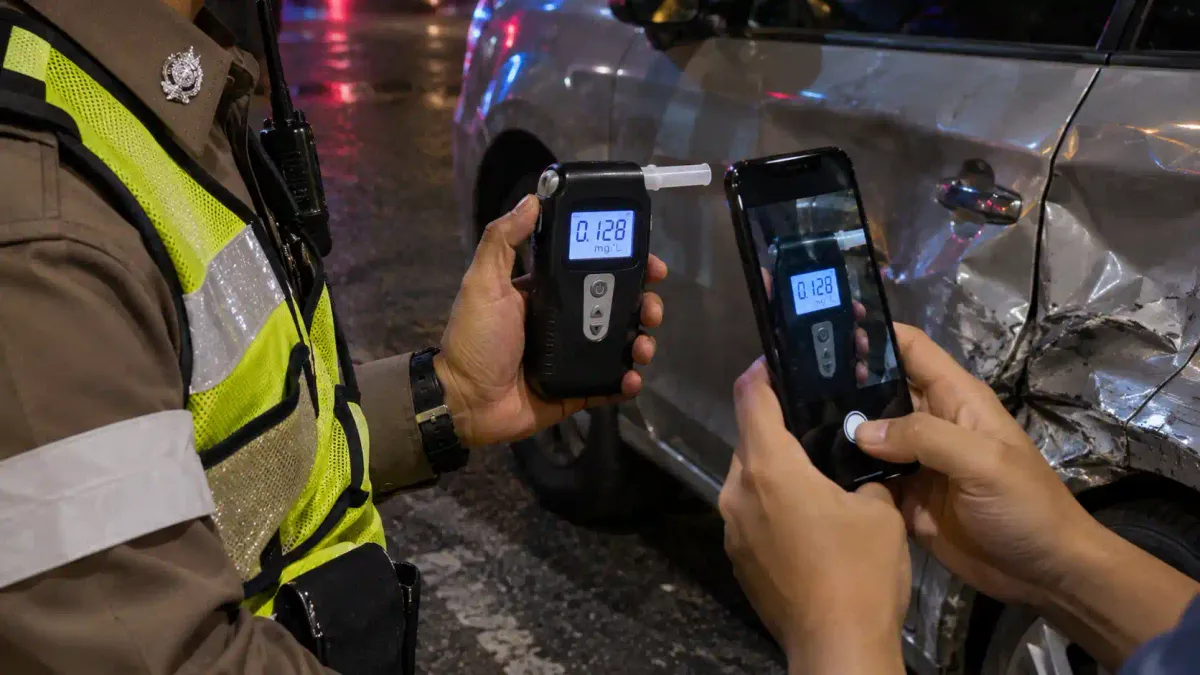
The complainant was driving a car that crashed on 1 October 2022 at about 23.30. The car had voluntary motor insurance with an insurer, and another company was the policyholder. Her account of what happened was as follows.
- The insurer, through two directors, sent a surveyor to inspect the scene.
- The surveyor photographed the result of the police breath-alcohol test, which showed her name, surname and national ID number, and sent it to the insurer. She called this covert photography.
- The director of the claims unit used the breath-test result as evidence in the letter refusing to pay the claim, sent to the policyholder.
- Another employee showed the result to officials of the OIC.
- She had consented to none of this.
Expert Committee Panel 1 sorted the six respondents as follows.
| Respondent | Status as found | Outcome |
|---|---|---|
| The insurer | Data controller, deciding on her data for its non-life insurance business | Considered |
| Two authorised directors | Not data controllers separate from the company | Not accepted |
| Director of the claims unit, and an employee | Employees of the company, not separate data controllers | Not accepted |
| The surveyor | Hired to survey the loss, collecting and using data as assigned by the insurer, so a data processor under Section 6 | Became the issue the insurer was warned about |
The panel relied on Section 5, paragraph one, under which the PDPA applies to the collection, use or disclosure of personal data by a data controller or a data processor.
Author’s view: this gate does not take staff conduct outside the PDPA. Section 73 lets a data subject complain when a data controller or processor, “including the employees or the service providers” of either, breaches the Act. Everything the staff did can be set out in the complaint, but the party that answers to the panel is the organisation. Naming directors and employees as extra respondents does not make the case stronger.
The complainant lost almost every point, yet the insurer was warned. Why?
Because the insurer had a surveyor collect data for it but made no data processing agreement with the surveyor, as Section 40, paragraph three requires. The panel issued a warning under Section 90, ordering the insurer to make that agreement, to follow its own guideline on collecting breath-test results, and to report back within 30 days. On every point the complainant raised, the panel found the insurer had acted lawfully.

Point by point, as the complainant raised them:
| She said | The panel found | Section |
|---|---|---|
| The insurer collected her name, ID number and driving data without consent | No consent needed: necessary to perform the insurance contract, to comply with non-life insurance law, and to verify the driver’s identity | 24(3), (5) and (6) |
| The surveyor photographed the breath-test result | Criminal-record data, but lawfully collected as necessary to establish or exercise legal claims, and for substantial public interest in the insurer’s duties as a licensed non-life insurer | 26(4) and 26(5)(e) |
| The insurer showed the result to the OIC | She had complained to the OIC herself about the refused claim; the insurer had a legal duty to explain, so lawfully collected data could be disclosed without consent | 27, paragraph one |
| She asked for erasure and was refused | Refusal lawful: the data was needed for legal claims; the insurer keeps it for 10 years from the end of the policy’s cover, based on the general limitation period | 33, paragraph two |
Criminal-record data is sensitive data under Section 26, which may not be collected unless an exception applies. The panel cited clause 3 of the PDPC Notification on protective measures for collecting criminal-record data not under the control of an authorised agency, B.E. 2566 (2023), which defines such data to include official or state-certified data on the investigation of a criminal offence. A breath-test result from a police device falls within that definition.
The document the company forgot
The panel raised, on its own, an issue that does not appear in the complaint as the document summarises it: the insurer had made no agreement with the surveyor.
A data processing agreement (DPA) is the agreement a data controller makes with anyone handling data on its behalf, setting out what they may do with the data and how they must protect it. Section 40, paragraph three says that when a controller assigns work to a processor, “the Data Controller shall prepare an agreement between the parties” to keep the processor’s work in line with the PDPA.
The panel cited two notifications that say what that agreement should contain.
- Clause 6 of the Security Measures Notification B.E. 2565 (2022): the controller should require the processor, in the agreement, to have appropriate security measures meeting the minimum standard, and to notify the controller of any breach.
- Clause 8 of the Notification on criteria and methods for personal data breach notification B.E. 2565 (2022): the agreement or contract must require the processor to notify the controller of a breach without delay and, where feasible, within 72 hours of becoming aware of it.
Under Section 90, paragraph one, which lets the panel order rectification or issue a warning before imposing an administrative fine, it made three orders.
- A warning to the insurer to make a data processing agreement under Section 40, paragraph three, and to supervise and control the processor’s work. The PDPC Office was told to record the warning in its database as a factor for consideration under clause 8 of the PDPC Notification on criteria for the Expert Committee’s administrative fine orders B.E. 2565 (2022).
- A warning to follow the insurer’s own guideline for surveyors, clause 3, paragraph three: when collecting data recorded by an official, such as a breath-test result, inform the official and the data subject why it is needed, ask the official’s permission, and keep evidence of that permission, of consent, or of the data subject’s acknowledgement, for example by having the official and the data subject sign the test document.
- Carry out orders 1 and 2 and report to the panel within 30 days of receiving the order.
(Decision 20/2567, ordered 6 December 2024)
Author’s view: three points are worth thinking about.
First, the insurer won every point the complainant raised, yet still ended up with a record. It had a legal basis for collecting, using and disclosing her data and for refusing erasure. What it lacked was one document between it and the surveyor, and that warning is now on file to be weighed if another case comes along.
Second, the insurer already had a guideline for surveyors, but it was not tied to an agreement. Clause 3, paragraph three of its guideline clearly says to ask the official’s permission before collecting a breath-test result. In the author’s view, this guideline fits the last paragraph of Section 26, which requires criminal-record data to be collected under the control of an authorised agency or with protective measures set by the Committee. A guideline that is not part of an agreement leaves the company unable to show that the surveyor was bound by it.
Third, the data reached the OIC because the complainant complained to the OIC herself. When a data subject complains to a regulator, the company has a duty to explain and to provide the relevant evidence to that regulator. Anyone about to complain should know that the evidence the company relied on to refuse them will go with its explanation. On keeping data after an erasure request, see EP.10 deletion requests refused, and on which clauses a processing agreement needs, see Data Processing Agreements: the clauses you cannot leave out.
Checklists for complainants and for organisations
Anyone about to complain should check the three gates first. Organisations should check the paperwork they tend to forget, above all agreements with outsiders who collect data on their behalf. Both checklists are the author’s view, worked from the three cases in this episode.
Before filing a complaint with the PDPC Office: 3 checks
- Is the data mine, as a natural person? If it is a company’s account data or documents, the PDPA is not the route; see whether a person’s data is mixed in, and let that person complain in their own name (15/2568)
- When did it happen? If before 1 June 2022, check whether the business is on the list annexed to the exemption Royal Decree; count from the date of the event, not the date you found out (1/2568)
- Complain about the organisation, not the individuals. Name the company that is the data controller as respondent, and set out what its staff, directors or contractors did as facts in the complaint (20/2567)
Paperwork organisations tend to forget: 4 points
- Make a data processing agreement with every outsider who collects data for you, such as surveyors, agents, collection agencies or field contractors, covering security measures and a duty to report breaches within 72 hours, as the two notifications the panel cited require
- Tie your working guidelines to the agreement. If you already have guidelines, have the agreement refer to them and have the contractor sign to acknowledge them
- Have rules for photographing documents held by officials: ask the official’s permission, tell the data subject, and keep evidence, such as signatures on the test document, as in the guideline the panel told the insurer in the third case to follow
- Set retention periods as numbers and be able to say where they come from. The insurer in the third case could refuse erasure because it had set 10 years from the end of the policy’s cover and could explain that it was based on the general limitation period
The “PDPA Case Files” series: our data in the hands of banks and insurers
This set has six episodes (EP.08 to EP.13) on real complaints against banks, insurers and financial institutions. This is the last episode of the set. Every story is summarised from decisions of Expert Committee Panel 1.
| Episode | Topic | Key question |
|---|---|---|
| EP.08 | Insurance sales calls that won’t stop | Where did they get my number, and must they stop when I opt out? |
| EP.09 | Bank marketing and consent | When is consent in a banking app not free? |
| EP.10 | Deletion requests refused | Which laws let banks and insurers keep data? |
| EP.11 | Debt and credit | How far can debt collection go through other people? |
| EP.12 | Who opened my account? | Whom does an access log protect, and what must it record? |
| EP.13 | Complaints that never reached the merits (this episode) | Three gates before the merits, and the agreement the insurer forgot |
Every decision in the series is collected in one table at Thailand PDPA decisions.
Let Kooru check your agreements with the contractors who collect data for you
Kooru — PDPA & AI law advisory for Thai businesses — lists the contractors who collect or use data on your behalf, checks whether each has a data processing agreement, and drafts agreements tied to your field guidelines. In the third case the insurer had a legal basis for every point and was still warned over the one document it lacked.
1. A business-wide gap check in 3 working days
Start with Kooru Data Shield, Assessment package, 5,900 baht. Our legal team reviews your privacy notice, security measures and processor agreements, and sends a report with a fix plan within 3 working days.
2. Monthly DPO service
If your business relies on field contractors, agents or surveyors and handles complaints regularly, see Kooru’s DPO as a Service.
Contact us
Message us on LINE @kooru and tell us briefly who collects data on your behalf and which of them you have agreements with. The Kooru legal team replies during business hours, and the first 15-minute consultation is free.
Something to think about
In none of these three cases did the panel say that what the complainant described did not happen. The company in the first case may well have had its account data disclosed; the agent in the second admitted the disclosure; the driver in the third really was photographed. But the first two ended at a gate before the merits, and the third ended on legal bases the insurer had in place.
What got the insurer warned was not anything the complainant raised. It was a document the insurer should have had all along.
Author’s view on the next 6 to 24 months: as events before 1 June 2022 recede, the second gate will close fewer complaints. The author expects more complaints to reach the merits, and the question the panel asks companies more often to be “who collects data for you, and do you have an agreement with them?” The more a company relies on outside contractors, field apps or AI tools to collect data in place of staff, the longer its list of processors grows, and each one needs an agreement under Section 40, paragraph three.
The question every organisation should be able to answer is: “if the panel asked today for our agreement with everyone who collects customer data on our behalf, could we hand over all of them?”
Frequently asked questions (FAQ) on PDPA complaints that are not accepted
1. Can a company file a PDPA complaint with the PDPC Office?
Not as a data subject. In decision 15/2568 the panel found that Section 6 defines “person” as a natural person, so only a natural person can complain under Section 73. A company is a juristic person, and the complaint was not accepted under Section 74 together with clauses 13(1) and 14(1) of the complaints Regulation B.E. 2565.
2. What can a company do if its account data is disclosed?
In the author’s view, it can still use other laws, such as its rights under its contract with the bank or a civil claim for damages. If the disclosed documents contained a director’s or employee’s data as a natural person, that person should be able to complain in their own name about their own data. Decision 15/2568 did not rule on this.
3. Can I complain under the PDPA about an event before 1 June 2022?
It depends on whether the business is on the list annexed to the exemption Royal Decree. In decision 1/2568 the insurance business was exempt from Chapters 2, 3, 5, 6 and 7 and Section 95 from 27 May 2020 to 31 May 2022. An event in March 2022 was therefore not subject to the PDPA, and the complaint was not accepted under Section 74, paragraph two, and clause 13(3).
4. Can I complain about a company’s directors or employees individually?
In decision 20/2567 the panel did not accept the complaint against two directors and two employees, because they were not data controllers separate from the company. Under Section 5, paragraph one, the PDPA applies to data controllers and data processors. Staff conduct can still be described in the complaint, since Section 73 covers the employees and service providers of a controller, but the party that answers is the company.
5. Is it a PDPA breach for a surveyor to photograph my breath-test result?
In decision 20/2567 the panel found the breath-test result was criminal-record data under Section 26, but the insurer could collect it as necessary for legal claims under Section 26(4) and for substantial public interest under Section 26(5)(e). Even so, the panel ordered the insurer to follow its own guideline: ask the official’s permission and keep evidence of permission, consent or the data subject’s acknowledgement.
6. When is a data processing agreement (DPA) required?
Whenever a data controller assigns someone else to collect, use or disclose data on its behalf. Section 40, paragraph three requires the controller to put an agreement in place. In decision 20/2567 the insurer had no agreement with its surveyor, so it was warned under Section 90, had to make the agreement and report within 30 days, and the warning was recorded in the PDPC Office’s database.
7. Can an insurer refuse to erase accident data?
In decision 20/2567, yes: the insurer needed the data for legal claims under Section 33, paragraph two. It keeps such data for 10 years from the end of the policy’s cover, based on the general limitation period.
References
- Expert Committee Panel 1, Office of the Personal Data Protection Committee. (7 Nov 2025). Decision 15/2568: complaint not accepted for consideration (a company complaining that a bank disclosed its account data)
- Expert Committee Panel 1. (7 Feb 2025). Decision 1/2568: disclosure of personal data without consent (a life-insurance agent disclosing policy-loan details)
- Expert Committee Panel 1. (6 Dec 2024). Decision 20/2567: unlawful collection, use or disclosure of personal data (a surveyor and a breath-test result)
- Personal Data Protection Act B.E. 2562 (2019), Sections 5, 6, 24, 26, 27, 33, 40, 73, 74 and 90
- Royal Decree prescribing agencies and businesses whose data controllers are exempt from the PDPA B.E. 2563 (2020) and No. 2 B.E. 2564 (2021), Sections 2 and 3, as cited in decision 1/2568
- PDPC Regulation on the filing, non-acceptance, termination, consideration and time frames of complaints B.E. 2565 (2022), clauses 8(1), 13(1), 13(3) and 14(1)
- PDPC Notifications on Security Measures of the Data Controller B.E. 2565 (2022), clause 6, and on criteria and methods for personal data breach notification B.E. 2565 (2022), clause 8
- PDPC Notifications on protective measures for collecting criminal-record data not under the control of an authorised agency B.E. 2566 (2023), clause 3, and on criteria for the Expert Committee’s administrative fine orders B.E. 2565 (2022), clause 8, as cited in decision 20/2567
- AiPDPA. Data Processing Agreements: the clauses you cannot leave out, https://aipdpa.com/en
This article is general information for business decisions, not legal advice for a specific case. The stories summarise published complaint decisions. Sections marked as the author’s view are additional analysis, not part of the decisions. We do not name people, organisations, banks or insurers, to keep the focus on the principles. Statutory quotations in English are from unofficial translations; the Thai text governs.
Legal analysis and review by: Phuwara Krobtaku, Thai Barrister (licence 477/2558) · LL.M. IP & Information Law · DPO | Founder of Kooru — PDPA & AI law advisory for Thai businesses

About the author: Phuwara Krobtaku
Licensed lawyer no. 477/2558 · Thai Barrister-at-Law · LL.M. Intellectual Property & Information Law (gold medal) · DPOMore than 20 years in IT and digital marketing before law. Founder of Kooru, a tech-law advisory handling PDPA, AI governance and intellectual property for SMEs.